Established in January 2020, Sub Rosa began as a digital journal dedicated to highlighting points of inspiration—a reflection of the systematic groundwork behind one’s practice. Within these pages, you’ll find the people, objects, moments, locations, and histories that have motivated me.
All views are my own.
In Honor of Patricia Johanson | 2024
Groundswell: Exploring the Consciousness of Land Art
Land art, a movement where Earth finds itself as both concept and medium, has historically been dominated by male artists. However, the comprehensive exhibition Groundswell: Women of Land Art, curated by Leigh A. Arnold and on view at the Nasher Sculpture Center in Dallas, spotlights the women who have made significant contributions to the field.
The exhibition features the work of 12 artists, each offering a unique perspective on our relationship with the land: Lita Albuquerque, Alice Aycock, Beverly Buchanan, Agnes Denes, Maren Hassinger, Nancy Holt, Patricia Johanson, Ana Mendieta, Mary Miss, Jody Pinto, Michelle Stuart, and Meg Webster. Arnold thoughtfully organizes over 100 works by the artists around thematic ideas, fostering a powerful dialogue throughout the exhibition. Above the museum’s vestibule entrance is a sphere of small branches in tandem among the concrete and metal structures that make up the ceiling of the Nasher. It’s a site-specific piece by Maren Hassinger and the first work to introduce visitors to the showcase before check-in.
Arnold has been with the Nasher for 10 years. Her doctoral thesis focused on the unfinished works of Robert Smithson, one of land art’s most prominent artists, which adds a compelling academic foundation for curating Groundswell. Perhaps a subtler reason for her connection to this exhibition is her experience living in Nebraska and Texas—states that, with their vast, open landscapes, naturally invite contemplation and ideation. Arnold's curatorial vision aims to expand beyond the narrow canon of land art, underscoring the significant contributions of women artists to this movement and others, with nuanced approaches that transcend gender boundaries.
One of the central themes of the exhibition is the freedom these artists found within the land art movement. Rather than imposing their will on the landscape, these women’s works are often additive, rooted in a spirit of collaboration with the Earth rather than a desire to control it.
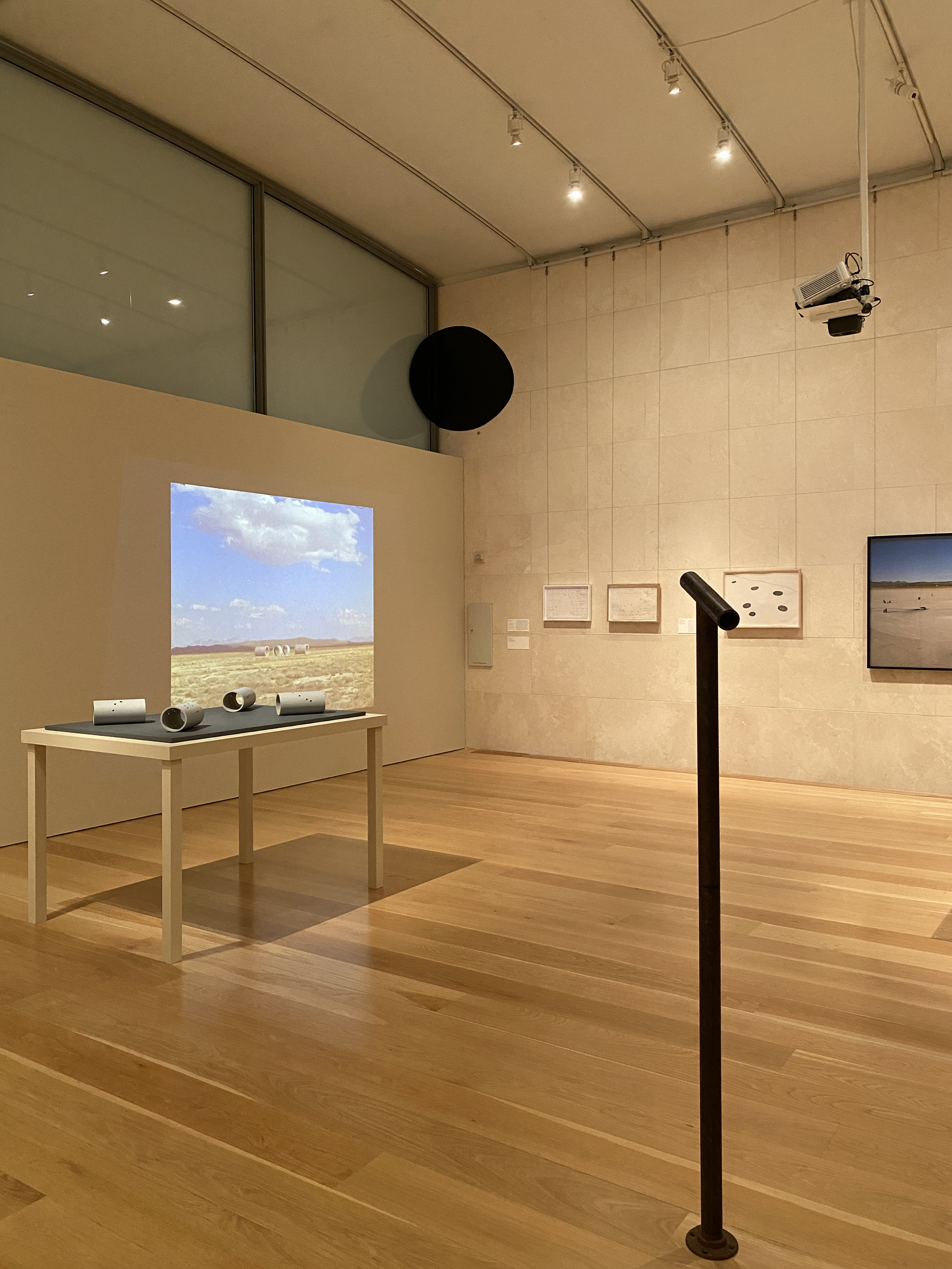

The exhibition spans almost the entire museum, with the exception of a smaller gallery in the center, which still features work from the Nasher’s permanent collection that specifically relates to Groundswell. Somewhat ironically, the museum’s sculpture garden displays only two works from the exhibit: Nancy Holt’s Pipeline, which winds through the museum and extends outdoors, and Michelle Stuart’s Marici: Light of the Dawn, which is partially submerged in water. Within the galleries, a notable commonality when engaging with nature as subject matter is the emphasis on color and texture. Raw, natural hues—clay red, dusted pink, sky blue, fresh green, wilted yellow, concrete grey, dirt brown, and others—are omnipresent in a compelling way. Beyond the gallery walls is Patricia Johanson’s Fair Park Lagoon (1981-86).


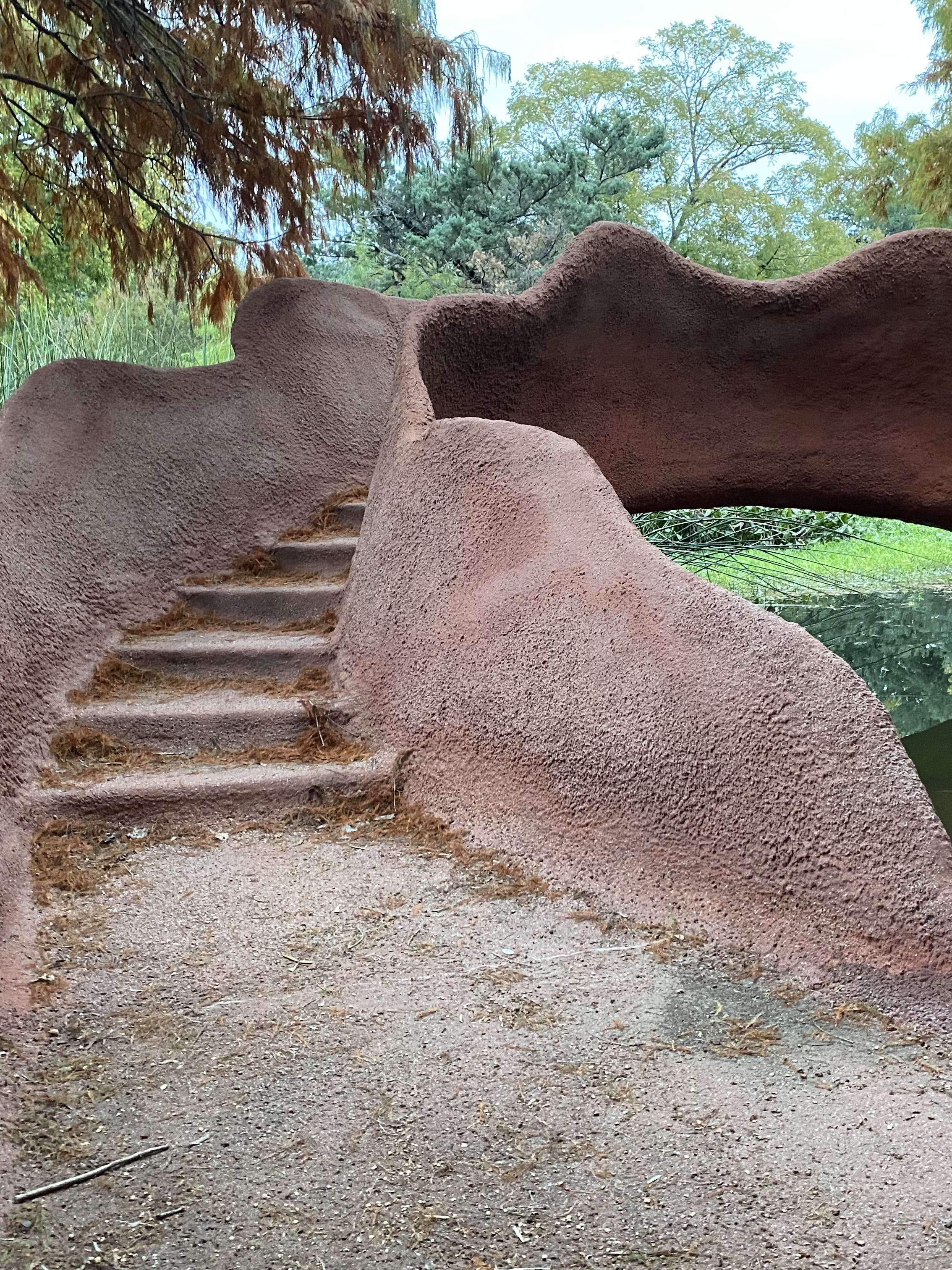


Growing up in Dallas, I can attest to the transformative experience of visiting Johanson's sculpture. This piece, completed in 1986, is an exceptional example of land art that blends seamlessly with the environment and functions as a successful public artwork. Johanson's approach was not about imposing on nature but restoring the ecosystem, showing the power of artists in conversation with the Earth. As a child, I saw the lagoon, shrouded in mystery, as a living, mythical creature lurking beneath the water’s surface—a symbol of the magic of imagination.
The power of land art lies in its ability to speak to us, even without the need for explanations or context. It becomes a conscious force of nature, inviting us to ask questions and explore the art within the Earth itself. Groundswell encourages us to appreciate these poetic acts that women artists have contributed to the movement, reclaiming the history of the Earth's transformation into an art form.
Chronicles | 2023
My intent for Sub Rosa is to provide access to curated information centered on art and activism. Valuing my time as an artist, I’ve been thinking of a way to offer readers the choice to pay for my chronicles. Below is an option to support my project for as little as $1 one time or however you’re comfortable.
A R T
2023 As Saved in My Phone
Dallas Museum of Art
Matthew Wong: The Realm of Appearances on view October 2022 - February 2023


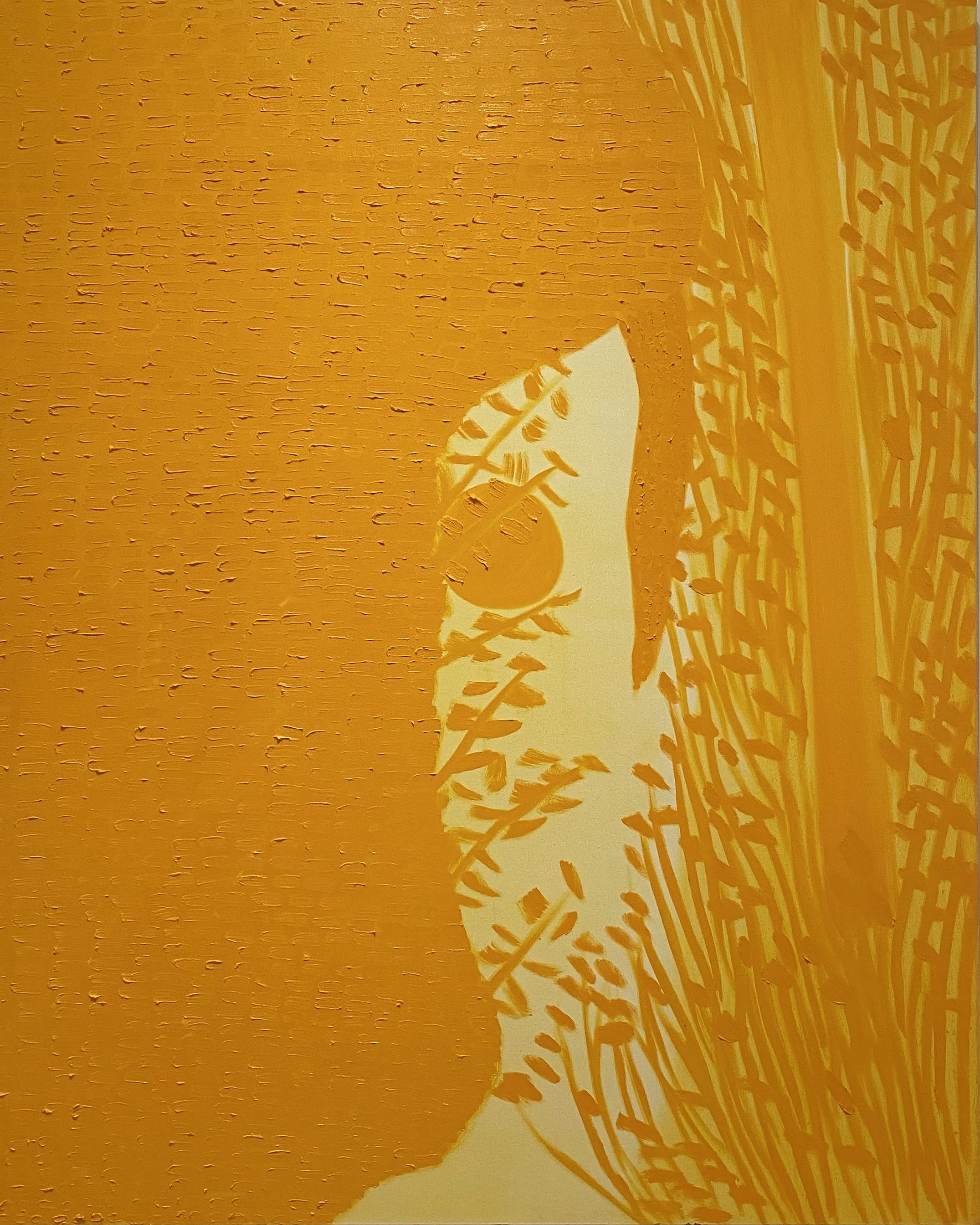
Self-taught artist Matthew Wong worked alongside his challenges with autism and tourettes. He swiftly rose to critical acclaim within a six-year career and tragically passed at 35 in 2019. In the article Matthew Wong’s Life in Light and Shadow by Raffi Khatchadourian, Raffi follows Matthew’s life from childhood to 2019 with conversations and studio visits by his mother, Monita, co-founder of The Matthew Wong Foundation.
‘Monita and I entered an antechamber, where some canvases were stacked, and she paused. She had warned me that she could tolerate only a brief time inside. Wong’s paintings—mostly imagined landscapes—are portals to luminous, vibrant, moody places. Though not surreal, they are the product of reverie: poetic concoctions inspired by memory, stray ideas, or the paint itself as he compulsively worked it. Midnight forests glow, somehow, without light, by a painterly magic. A milky tundra extends across a horizon, looking soft, opulent, ominous. Spectral icebergs—vulnerable, tentative, lost—drift in glasslike seas.’ Matthew Wong’s Life in Light and Shadow by Raffi Khatchadourian for The New Yorker published May 9, 2022.
I only got to zoom through his retrospective, which traveled to the DMA once. I had little to no knowledge of his work and wished I could stay a little longer, a little longer, and more until I was at the museum 10 minutes past closing time (sorry!). At first glance, the works seemed abstract, with glimpses into figuration emerging, and slowly, the struggle between Matthew’s grasping at his emotions, realities, dreams, troubles, and triumphs came to show itself.
More saves from the DMA in 2023 are below.


The Modern Art Museum of Fort Worth
I’ll Be Your Mirror: Art and the Digital Screen on view February 2023 - April 30 2023


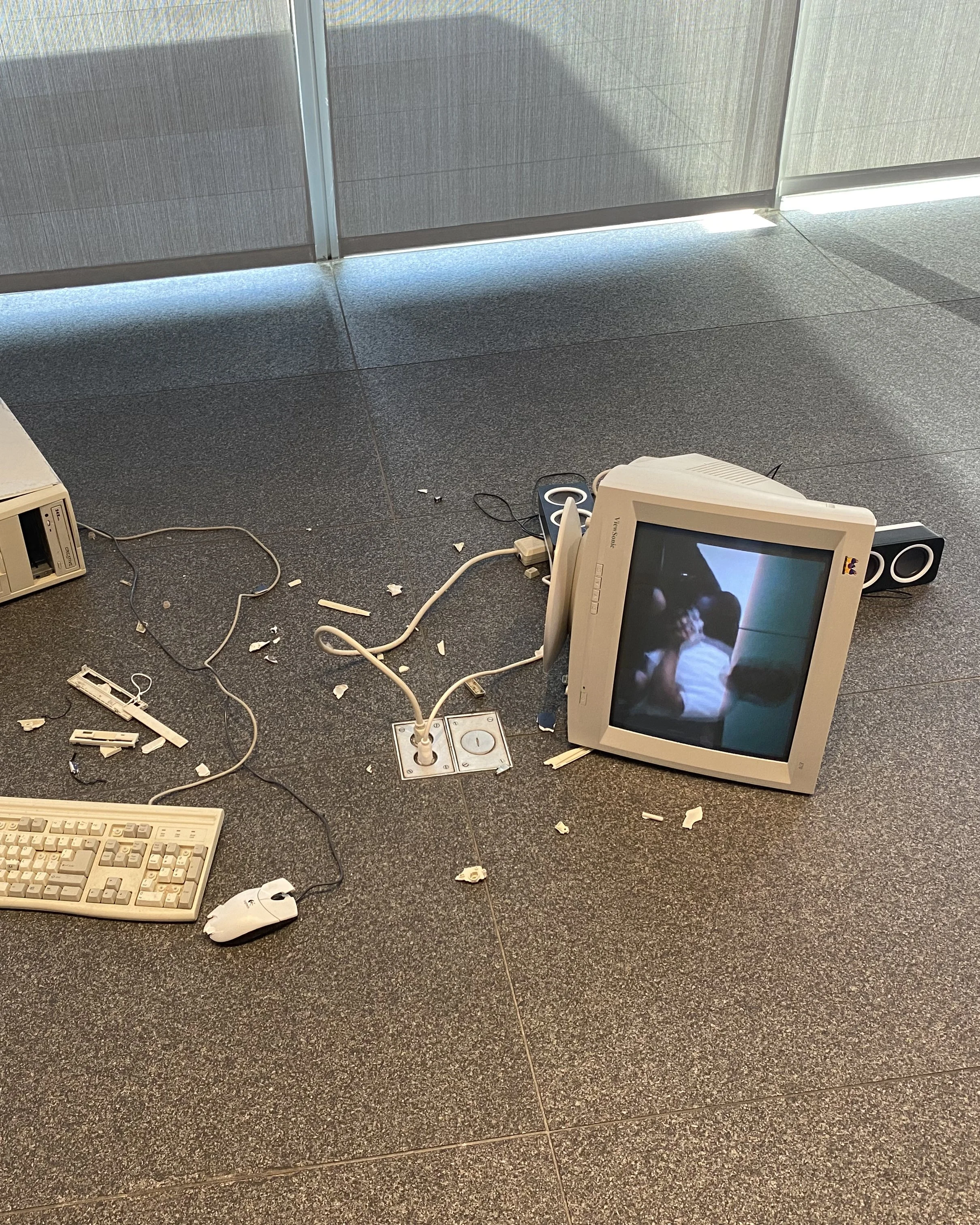


I'll Be Your Mirror: Art and the Digital Screen explored the impact of screens on art from 1969 to the present. The exhibition comprised over sixty works by fifty artists who have used various media such as paintings, sculpture, video games, augmented reality, and video.
The exhibition focuses on the pervasive influence of screens in contemporary life, examining their role in shaping culture, connectivity, surveillance, digital abstraction, and more. The show has nine key themes: liminal space, connectivity, surveillance, the repository, digital abstraction, the posthuman body, automation and the loneliness epidemic, ecology, and turning a mirror on ourselves.
Curated by Alison Hearst, I'll Be Your Mirror: Art and the Digital Screen stands out as one of the past decade's most in-depth explorations of art and digital technology in the Southwest region. It was scheduled way too short for such a comprehensive exhibition and exceptionally groundbreaking to view here in Texas.
The Warehouse
Open Storage: 25 Years of Collecting on view August 2022 - April 2023


Formed by Dallas-based art collectors Cindy and Howard Rachofsky, The Wearhouse is home to their post-war modern and contemporary art collection that feels a little bit classified yet proud to be locally located.
Curated by Allan Schwartzman, Open Storage: 25 Years of Collecting comprises 216 works by 148 artists and is stated to be roughly 20 percent of the collection. The wayfinding of the exhibition worked in chronological order of the works acquired.
Browse the checklist for a good time, linked here.
The Nasher Sculpture Center
2023 Nasher Prize Laureate Senga Nengudi on view February - April 2023


Born in Chicago in 1943, Sengra Nengudi has been a prominent figure in the contemporary art scene since the 1960s. Her work often explores the intersections of identity, race, gender, and the body. Known for her innovation using materials like pantyhose and sand, Nengudi’s interest in art and dance has shaped her practice and ability to push boundaries.
Groundswell: Women of Land Art on view September 2023 - January 7, 2024


Land art, a movement where the Earth finds duality as canvas and medium, has historically been dominated by male artists. However, the comprehensive exhibition Groundswell: Women of Land Art, on view at The Nasher Sculpture Center curated by Leigh A. Arnold, shifts the spotlight toward women who have made significant contributions to the field.
Arnold has been at the Nasher for ten years. Her doctoral thesis covered the unfinished works of Robert Smithson, one of Land art’s most prominent artists, making for a compelling academic case to take on mounting Groundswell, but perhaps an additional and less obvious reason is her experience living in Nebraska and Texas, states that lend to contextualizing how the vast and sprawling land can be a source for ideation. Arnold's curatorial vision clearly aims to move beyond the narrow canon of land art, making it evident that female artists have contributed significantly to this movement and others, having their own nuanced approaches that transcend gender boundaries.
The exhibition encompasses almost the entire museum except for a smaller gallery in the middle of the institution, but even then, this features work from Nasher’s permanent collection that specifically relates to Groundswell. The museum’s sculpture garden, somewhat ironically, displays only two works from the exhibit, including Nancy Holt’s Pipeline, which winds throughout the museum, making its way outside, and Michelle Stuart’s Marici: Light of the Dawn, which is submerged in water. Within the galleries, a commonality that shows when dealing with nature as the subject matter is color and texture. Raw and natural hues of clay red, dusted pink, sky blue, fresh green, wilted yellow, concrete grey, dirt brown, and so on are omnipresent in a special, compelling way.

Nancy Holt, Pipeline, 1986

Nancy Holt, Pipeline, 1986
Described as ‘beyond the gallery walls’ is Patricia Johnson’s Fair Park Lagoon, (1981-86).
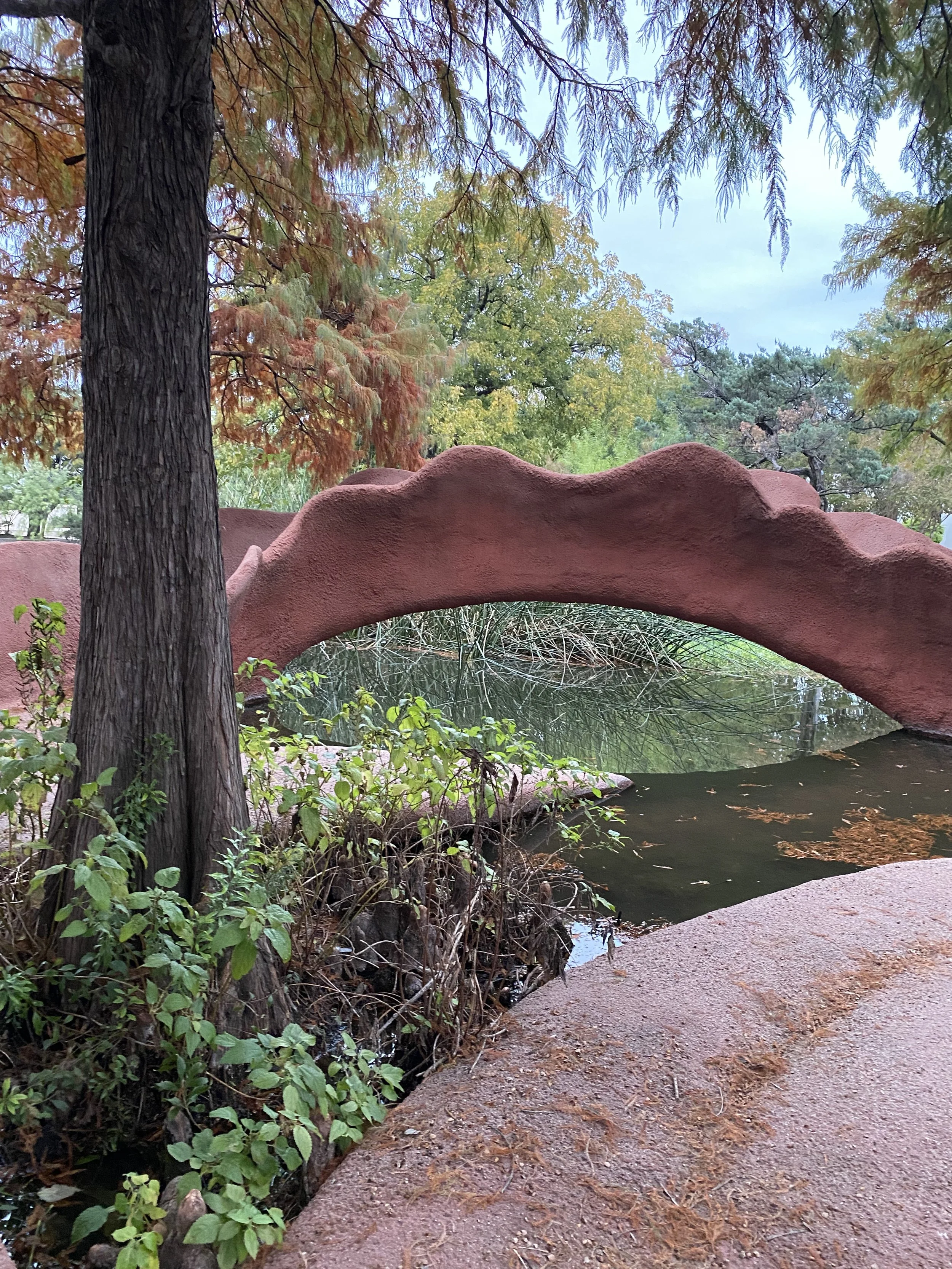
Patricia Johnson, Fair Park Lagoon, (1981-86)
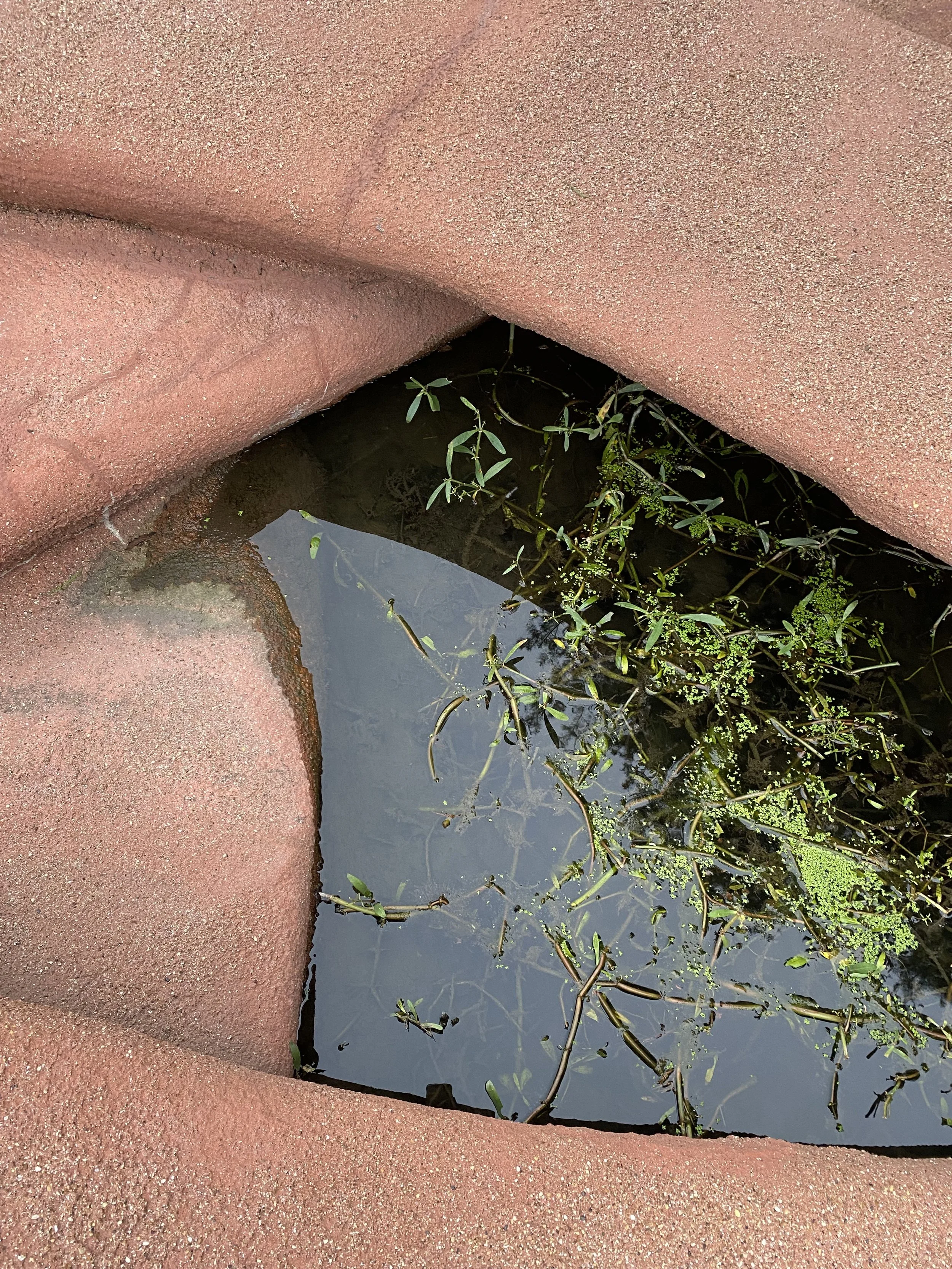
Patricia Johnson, Fair Park Lagoon, (1981-86)
As a Dallas native, I can personally attest to the transformative experience of visiting Johnson's sculpture. Her work is an exceptional example of land art that blends seamlessly with the environment and functions as a successful public artwork. Johnson's approach was not about imposing on nature but restoring the ecosystem, showing the power of artists in conversation with the Earth. As a child, the lagoon, shrouded in mystery, once seemed like a living, mythical creature lurking beneath the water's surface to me. It was a symbol of the magic of imagination.
Not-Gallery Shows
Dallas-based artists, curators, and activists who utilize non-traditional art spaces to showcase work provide greater flexibility for experimentation while still adhering to the formative constraints of the given architectural parameters.




Odyssey Studios housed space for the exhibit The Compass Of Our Stuggles, organized by the Palestinian Youth Movement, honoring Palestinian prisoners and martyrs by installing text and images of stories directly related to the North Texas community. An interactive aspect was the duaa wall, where visitors could leave written notes of solidarity.
Chateau Chateau, organized by Joel Murray and Clint Bargers, takes place annually inside the Aldredge House on Swiss Avenue, with twenty artists working inside, activating rooms, corners, tubs, walls, and crevices. Exploring the show felt like being inside an artist-made funhouse.
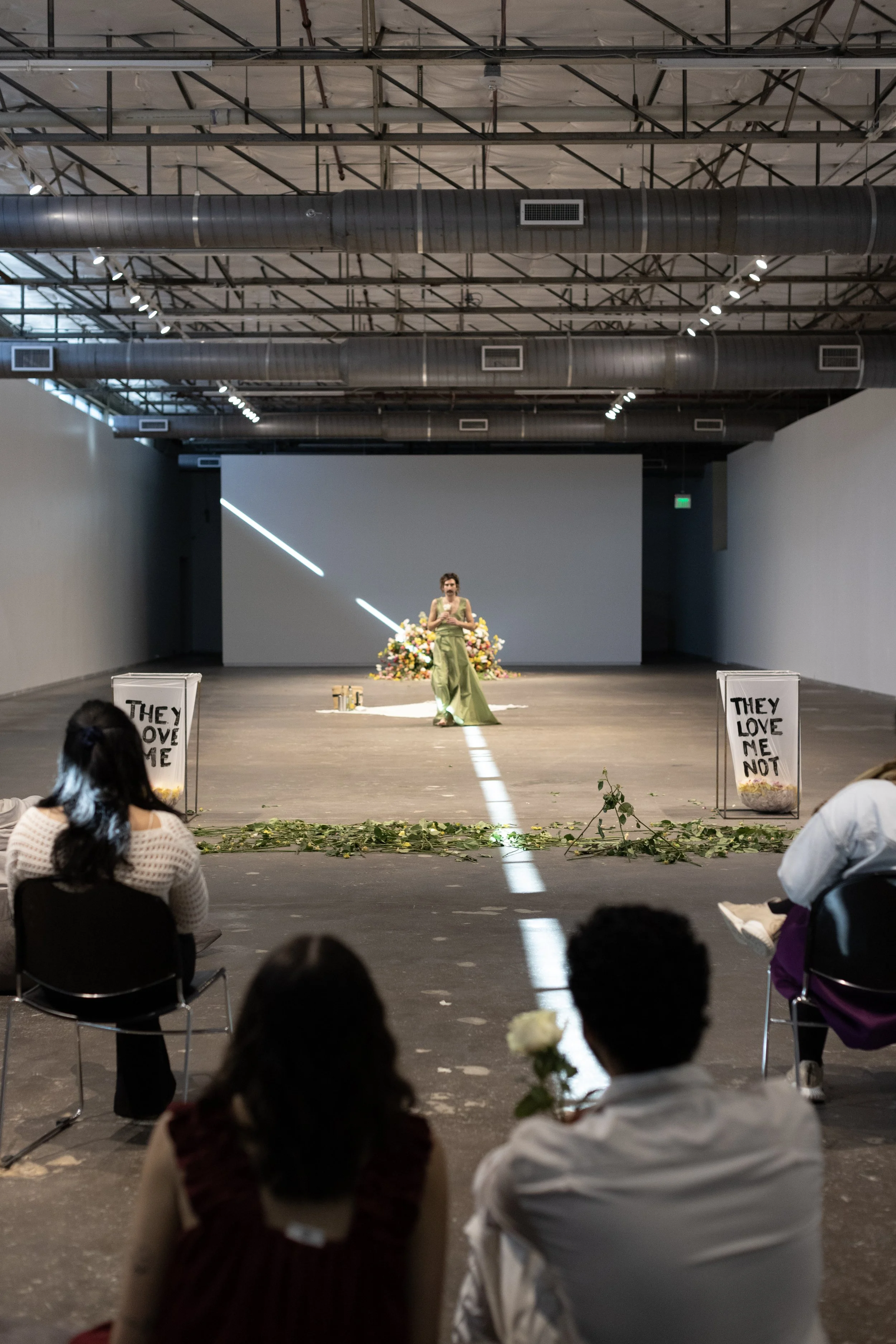
DC EMPTY, Dallas Contemporary’s time-based programming highlights regional artists as a way for the museum to utilize unused space during rotating exhibitions and serve the Dallas creative community. Colton James White’s DC EMPTY iteration, They Love Me, They Love Me Not, was a 5-hour durational piece of pacing, plucking flowers, a moment of pause for lunch, and a cathartic ending in an exhausting game of they love me, they love me not.
Refer to fig. 361 curated by Jillian Wendel featured artists Aliyah Cydonia, Hannah Baskin, and Jose Vasquez Ramirez throughout a space that lent it’s history and constructions conceptually to the work.
L I T E R A T U R E
Saved and Yet to Read
In a way, each book has themes of complexities of individual identity, exploring how personal experiences, mental health, and societal forces shape who we are and ways to transform and escape from those societal norms.

Strangers to Ourselves: Unsettled Minds and the Stories That Make Us by Rachel Aviv
‘“Strangers to Ourselves” delicately balances two truths that prove remarkably difficult to hold in tandem. We all have our own minds, our own experiences, our own suffering; we are also social creatures who live among others, and social forces have at least some bearing on how we understand who we are. Aviv suggests that we continue to cling to reductive theories about brain chemistry because “the reality — that mental illness is caused by an interplay between biological, genetic, psychological and environmental factors — is more difficult to conceptualize.”’

Kitchen by Banana Yoshimoto
‘According to the author herself, the main themes in her work are "the exhaustion of young Japanese in contemporary Japan" and "the way in which terrible experiences shape a person's life" — additional issues explored in "Kitchen" include transexuality and the loneliness inherent in modern Tokyo life.’

The Sweet Indifference of the World by Peter Stamm
‘Christoph and Magdalena. Chris and Lena. Peter Stamm’s latest novel, The Sweet Indifference of the World, is a short, sophisticated tale for the post-truth era, in which four identities become irreparably intertwined.’

‘Being thoroughly trained in semiology, sociology, phenomenology, psychoanalysis with profound curiosity and humility, Shiff’s writing elevates the dignity of art as a fundamental form of human communication hence our survival. Elegantly designed as intended for broad readership, including art historians, art critics, artists, among other lovers of art, this volume is a must-read experience with pleasure and discovery.’
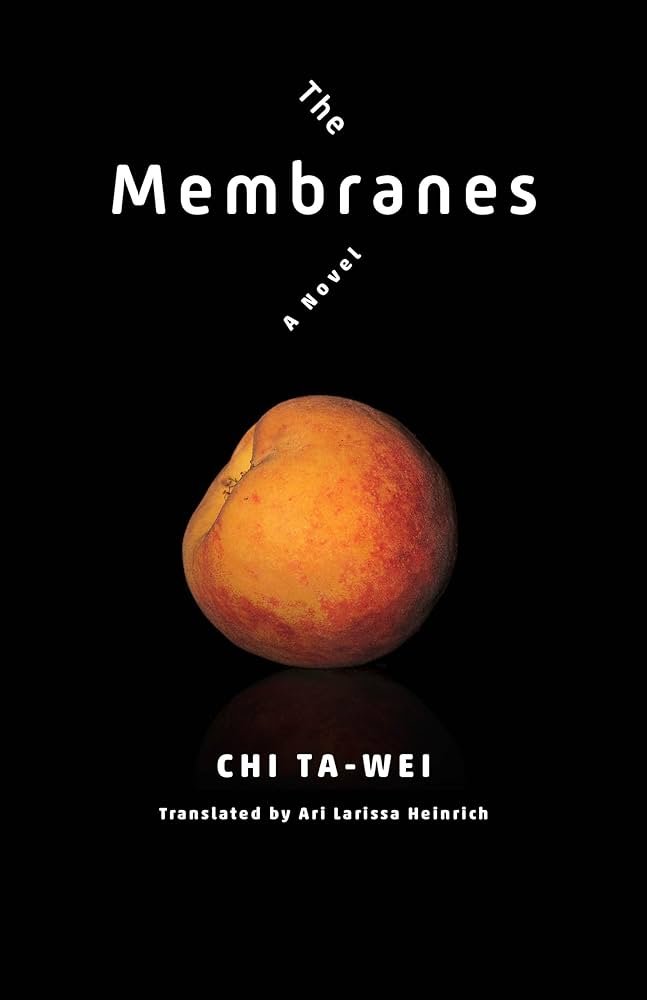
The Membranes by Chi Ta-wei
‘Taiwanese author Chi Ta-wei’s newly translated novel, “The Membranes,” was originally published in 1995 — and you can tell. This is a future extrapolated from the ‘90s, with books-on-disc and depleted ozone rather than the internet and climate change. And yet, though the book’s hereafter looks backward to us today, there’s something very timely about its play with gender fluidity and the social construction of identity. There’s also something timeless about Chi’s future, because of how it bends and defies time itself. The novel is about how identity is a story we tell ourselves through time — or back through time. And that story, for Chi, is queer.’

Easy Beauty by Chloé Cooper Jones
‘As “a woman with a body that could never be mistaken for symmetrical or orderly,” she long believed that the only way to deserve anyone else’s respect, much less desire, was to “be extraordinary in all other aspects,” brilliant and witty and humorous and cool. If the book is any proof, Jones is all these things. But there’s more to this gorgeous, vividly alive memoir.’

The Shop by Magazine B
‘Some might wonder why we chose to highlight brick-and-mortar shops amid our new normal. Since the onset of the pandemic, we’ve experienced firsthand the wonderful world of e-commerce. However, our restricted lifestyles have also helped us realize what kind of person we are, and subsequently, what gives us strength to keep going. For example, some people get energy from the ambience of a restaurant or its bustling environment more than the food. And some people enjoy the process of discovering new things in a brick-and-mortar shop more than the actual products. It doesn’t matter how great e-commerce services or algorithms get—these experiences will be forever nonpareil.’

Coffin Bound by Dan Watters
‘Chased by an unstoppable killer, Izzy Tyburn has decided that if the world won't have her in it, it can have nothing of her at all. She's re-treading her life, leaving nothing but burned rubber, ash, and the sun-scorched bones of those who get in her way.’
M U S I C
Screenshots Throughout the Year
I have a thing for trying to correlate seemingly unrelatable things, and really, this is a playlist of screenshots I took of songs I was listening to throughout the year, none of which I remember why. It’s exceptionally random but a testament to how music can sync to a feeling in a given moment. So if you’re open to a journey through damn near any genre under the sun, welcome?
Image credits Alexandra Hulsey
Chronicles | Midyear 2022
My intent for Sub Rosa is to provide access to curated information centered on art and activism. Valuing my time as an artist, I’ve been thinking of a way to offer readers the choice to pay for my chronicles. Below is an option to support my project for as little as $1 one time or however you’re comfortable.
All images by Alexandra Hulsey / embedded with source links.
A R T
Favorites So Far
It's been a while, and I thought reconnecting via another chronicle made sense in the middle of the year. Maybe Sub Rosa is a bi-yearly thing now. Anyways, I'd like to share some of the art I've enjoyed seeing so far. Found in New Orleans Museum of Art this July, Dallas Art Fair in April, and Latino Cultural Center in May.
Some commonalities in these artworks below are that they're fantastical, colorful, shapely, entertaining, and offered me a much-needed pause.
Larry Bell, Pacific Red (VI), 2016-2017. New Orleans Museum of Art.

Gert & Uwe Tobais, I don’t Want Love, 2022. Cassina Projects at Dallas Art Fair.

Joan Miró, The Red Disk, 1960. New Orleans Museum of Art

Stefanie Popp, Obelism (Skilos), 2020. Keijsers Koning at Dallas Art Fair.

Michael Henry Hayden, Internal Clock, 2020. Moskowitz Bayse at Dallas Art Fair.

Vladimir Waone, Melody of Unkown Moments, 2021. Sapar Contemporary at Dallas Art Fair.

Areum Yang, Until I Find My Home, 2022. Derek Eller Gallery at Dallas Art Fair.

Carol Bove, Mood, 2017. New Orleans Museum of Art.

Kapoor, Anish, Untitled, 1997. New Orleans Museum of Art.

Elizabeth Osborne, Zinnias With Chair, 2017. Barry Campbell Gallery at Dallas Art Fair.

Raymond Yeboah, New Beginnings. Latino Cultural Center, Dallas, TX.

Fabian Treiber, This Place, 2022. Anat Ebgi Gallery at Dallas Art Fair.
100 W Corsicana
Located in Downtown Corsicana, 100 W Corsicana serves as a prestigious creative residency for rigorously working artists from visual to literary. I visited for the first time in May for 100W x 10YRS, a celebration of the conception of 100 W Corsicana. The building and its surroundings are hauntingly beautiful. It inspired me to continue a project I explored in college, where you ink up a portion of a textured surface, place paper on top, and press into it to make a monoprint.
The application for 2023 residencies closed on September 1st, and I’m eager to see the next cycle of artists.

100 W Corsicana

Downtown Corsicana

Downtown Corsicana

STOREFRONT

100 W Corsicana

100 W Corsicana

100 W Corsicana

100 W Corsicana


The residency also has a bookstore called STOREFRONT, where you’ll find literature and artwork by resident participants. I picked up Tatiana Ryckman’s I Don’t Think of You (Until I Do) and, more recently, Seven Samurai Swept Away in a River by Jung Young Moon.
Corsicana reminded me how much I appreciate old buildings and old things, which in a way brings me to our road trip to New Orleans.
New Orleans
I've been to NOLA a lot, in fact, twice this year already, but I visited the New Orleans Museum of Art for the first time in July. It's relatively small, and its curation is one of my favorites I've ever seen! The vibrant modern art galleries displayed household named heartthrobs from Warhol, Modigliani, Kasner, and Miró with many others to have a unique conversation I felt like I was a part of. At the same time, the contemporary gallery focused on new acquisitions of work by BIPOC, LGBTQIA+, and female-identifying artists, which was badass in concept and execution. Outside was a massive sculpture garden that placed artwork complementary to the native swampy environment that felt otherworldly.
New Orleans has a lot of dualities to note, like placement/displacement, authenticity/facade, beauty/dismay, and stillness/chaos. I'm glad to have reflected on these this January and July, which felt especially meaningful in the context of 2022, if that makes sense. Some things feel new, some old, and there’s some new/old feelings, plus everything in between.




L O C A L
Dallas Artist Resources
Texas froze again in February, flooding circulated through the city in August, and temperatures reached as high as 109°F. throughout the summer, while the Dallas Climate Action seems over-ambitious for a city with 62 desert infrastructures.
One of the most significant ways individuals can make a change is to stop or cut down on meat and dairy in whatever way they can—also, taking agency on your own money. Consider alternative options for how much plastic accompanies what you're buying, what excess looks like for you, donating instead of throwing away, and research if the companies you shop at show actions against their role in climate change.
M U S I C
Something to listen to post-storm
Chronicles | January 2022
An Italian painter, a contemporary NYC photographer, Dallas's City Hall survey, and Valentine's Day playlist for January's 2022 chronicles.
My intent for Sub Rosa is to provide access to curated information centered on art and activism. Valuing my time as an artist, I’ve been thinking of a way to offer readers the choice to pay for my chronicles. Below is an option to support my project for as little as $1 one time or however you’re comfortable.
All images and links are directed to sources.
A R T
Domenico Gnoli illuminated objects in question and experienced their magic through painting
Fondazione Prada is a contemporary art museum co-chaired by Miuccia Prada and Patrizio Bertelli. In Milian, the museum's exhibition Domenico Gnoli showcases the artist's work from 1949 to 1969. The Prada namesake museum has steered away from poignant references to fashion, but Gnoli's paintings create a merge between garment and painting.
Domenico Gnoli (Rome, 1933 – New York, 1970) had worked as an illustrator, and set designer, then turned to large-scale paintings.
From the article The Peculiar Perfectionism of Domenico Gnoliby by Emma Harper for Apollo Magazine:
"As Gnoli himself explained in an interview with JeanLuc Daval for Le Journal de Genève, 'My themes come from the world around me, familiar situations, everyday life; because I never actively mediate against the object, I experience the magic of its presence.' As opposed to Pop's celebration of consumer culture, his paintings illuminate the objects in question. And while they can border on abstraction – it's easy to become so engrossed in a stitch, a pattern, or even a colour that you almost forget what you're looking at – his paintings revere the mundane, which is charged with a life force just outside of view."
Robe verte, 1967, by Domenico Gnoli. Image source: AnOther | original credits: Private Collection courtesy of Luxembourg + Co © Domenico Gnoli, by SIAE 2021

Capigliatura femminile, Riga in mezzo n.1,1965, by Domenico Gnoli. Image Source: AnOther | original credits: Collezione Prada, Milano © Domenico Gnoli, by SIAE 2021

Fauteuil N° 2, 1967, by Domenico Gnoli. Image Source: AnOther | original credits: Museo Nacional Thyssen-Bornemisza, Madrid © Domenico Gnoli, by SIAE 2021
Up and coming contemporary photographer Donavon Smallwood is one to watch

Donavon Smallwood’s series Languor. Image source: donavonsmallwood.com
Donavon Smallwood’s series Languor captures Black leisure at Central Park. For context, the word languor means the state of feeling, often pleasant, of tiredness or inertia. He took the images during the beginning of the pandemic and Black Lives Matter protests of 2020. The series was shot on black and white medium format film, lending a serine dream-like feeling. From January 21st to March 12th, 2022, images from Langour and a newer series, Beebe, will be displayed at The Print Center in Philadelphia.

Donavon Smallwood’s series Languor. Image source: donavonsmallwood.com
Exhibition statement from The Print Center:
A life-long resident of Harlem, Smallwood turned to the park as a refuge in the difficult days of lockdown and isolation due to COVID. However, it was not the bucolic landscape that drew his attention in the park, but the people within it – both neighbors and passersby. It was important to Smallwood for his sitters to feel comfortable – at home. “Its [“Languor’s”] subject is what it’s like to be a Black person in nature,” says Smallwood. Picturing Black people in this context references the history of Seneca Village, a 19th century Black community at the heart of what is now Central Park. “Languor” is influenced by that history as well as the artist’s own interest in the Romantic poet and artist William Blake, who is known for his transcendental works.
Smallwood will be doing a virtual artist talk presented by The Print Center on February 10th. Information is linked here.
Finding Donavon Smallwood’s work directed me to learn about Seneca Village. In an effort to commemorate the history, Central Park Conservancy has shared information on the Seneca Village community that was once a section of what is now Central Park linked here.
Both artworks mentioned can be purchased in book form!

“Domenico Gnoli” catalog available for purchase at Fondazione Prada. Image Source: Fondazione Prada.

Donavon Smallwood’s photography book Languor available for purchase at Trespasser. Image source: Trespasser.
L O C A L
Tell the city of Dallas what you really think
…about the city’s land-use policy! Here is a link to a survey conducted by City Hall where you can leave input on housing, parks, infrastructure, etc.
M U S I C
Get ready for Valentine’s Day with a love song playlist

Chronicles | October - December 2021
From The High Line to Fair Park, Laura Owen's mosaic at Laguardia Airport, details of artwork at the MoMA, The Noguchi Museum, The Whitney, Ciara Elle Bryant at The MAC, and Virgil Abloh.
My intent for Sub Rosa is to provide access to curated information centered on art and activism. Valuing my time as an artist, I’ve been thinking of a way to offer readers the choice to pay for my chronicles. Below is an option to support my project for as little as $1 one time or however you’re comfortable.
Hi there,
I’ve got no words other than this, just images I’ve taken the past three months as I aim to take life day by day. A click on the pictures will direct you to a corresponding article.
Happy New Year.
- A


Fair Park Closing Day, 2021
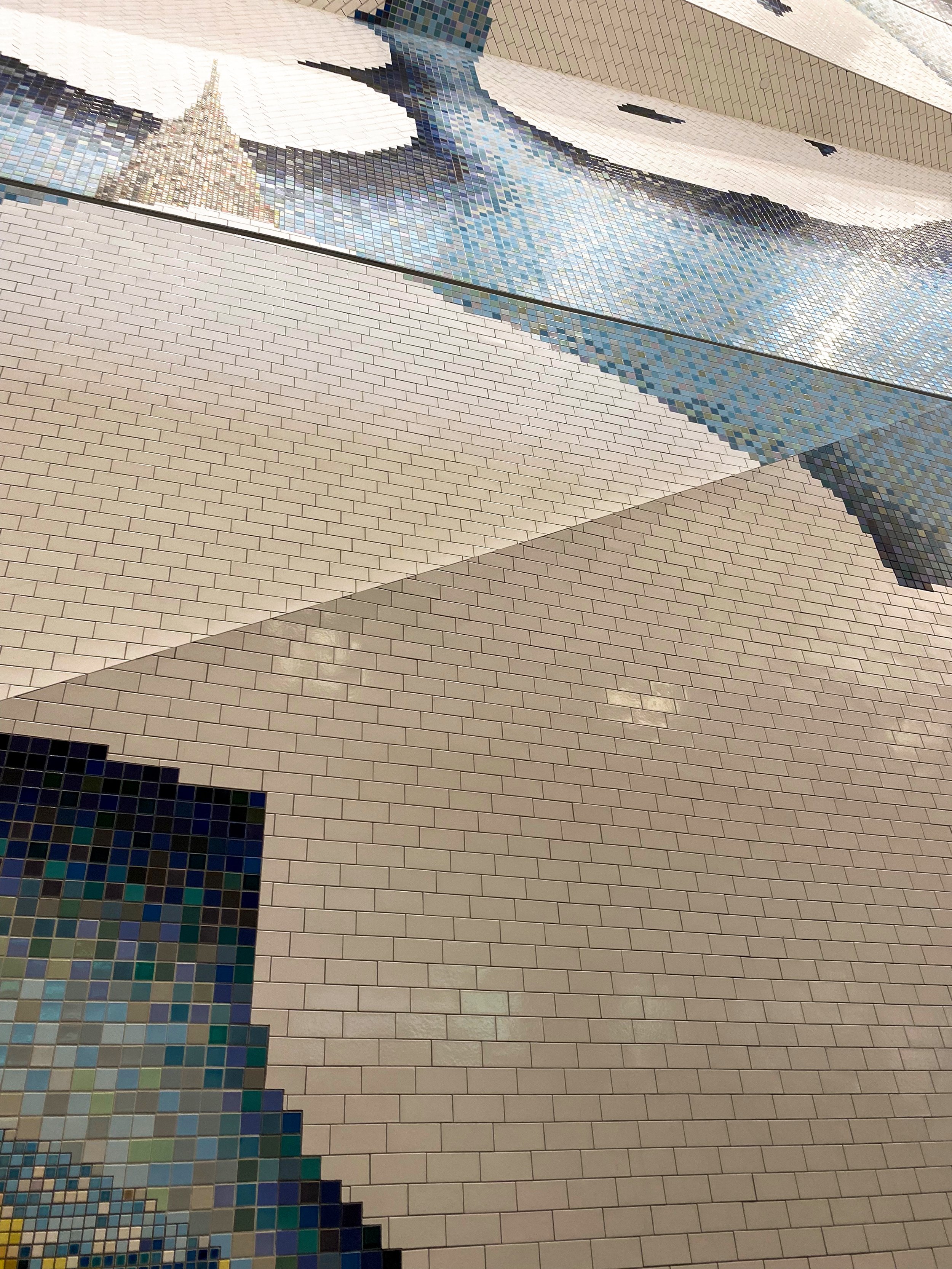
I?NY, Laura Owens, 2020.
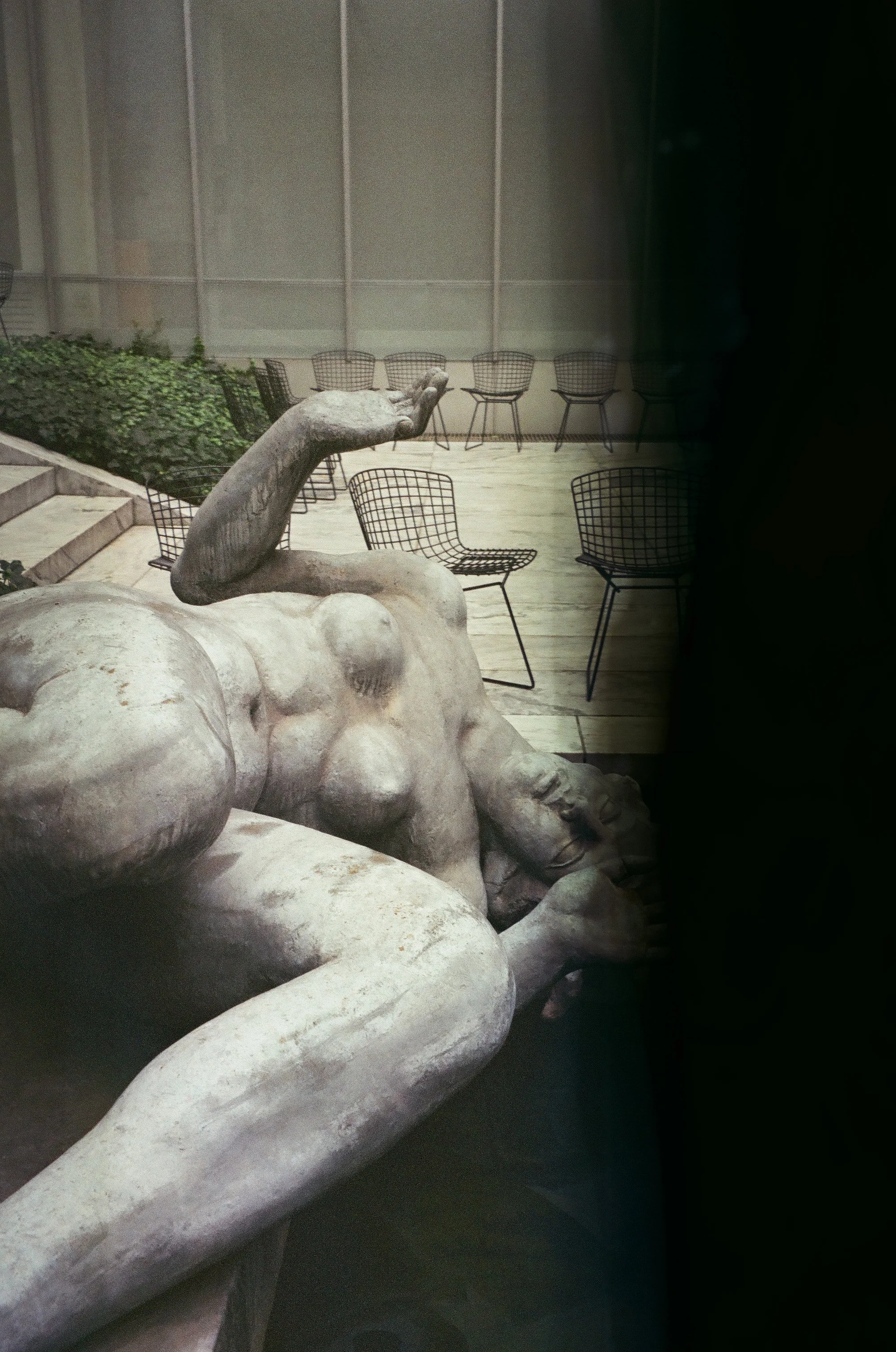
Aristide Mailloll, The River, Begun 1939; completed 1943

Bird Song, 1925 & Downward Pulling #2, 1972 by Isamu Noguchi

Unknown Title, Alexander Calder

Crime Suspect, Gordon Parks, 1957

The Migration Series, Jacob Lawrence, 1940-41

Hope II, Gustav Klimt, 1907-08

Little Id, 1970 by Isamu Noguchi

Akari Light Sculpture by Isamu Noguchi

Jacob’s Ladder, Helen Frankenthaler, 1957

Off-White’s, Virgil Abloh, 2021

Gaea, Lee Krasner, 1966

SERVER: Lova Ta, Love Ya’, Ciara Elle Bryant, 2021

Cupboard VIII, Simone Leigh, 2018
All images © Alexandra Hulsey
Chronicles | July - September 2021
Keeping the theme of resetting in mind, a breakdown of my influences from July - September 2021 is listed on this chronicle.
My intent for Sub Rosa is to provide access to curated information centered on art and activism. Valuing my time as an artist, I’ve been thinking of a way to offer readers the choice to pay for my chronicles. Below is an option to support my project for as little as $1 one time or however you’re comfortable.
Hello,
I’m back from hiatus.
Now, Sub Rosa is a one to three months or, whenever-I-feel, chronicle. I began publishing things I found meaningful as an archive throughout the month for personal and communal benefits. When I’m feeling uninspired or pressured to post, it feels disconnected. So, I took some time to reset which, is a loose theme of what I found inspirational during July, August, and September 2021.
Enjoy!
-A
Art & Photography
Yes and No
One of the first things and artist may learn is; understand the rules of your medium before you break them. Photo No-Nos is a book by photographer and author of The Photographer’s Playbook, Jason Fulford. Photo No-Nos features several contemporary photographer’s approaches to what they deem as off-limits. Each photographer takes the prompt in different directions, from humorous to serious.
Personally, every cliche I could think of; flowers, buildings, sunsets, pets, food, are some of my favorite things to capture. I believe the execution and intent matters more.
Speaking of photo no’s, one is gatekeeping information from each other. Fuck Gatekeeping provides photographers resources on the industry created by Carmen Chan, Emiliano Granado, and Jared Soares. Categories include business, marketing, personal work, and money. Even if you aren’t a photographer, it’s worth checking out. The information is relevant to many careers, and it offers insight into a photographer’s role.
White Rock Lake, Alexandra Hulsey, 2021
An Artists Uniform
Artists often choose their wardrobes in response to their practice subconsciously or not. It could be simple, convenient, eccentric, political, etc. Undeniably a certain look can be associated with a figure for example, Bill Cunningham and his blue jacket.
What Artists Wear by Charlie Porter is a book that archives iconic artists and their clothes. Looking at these wardrobes inspires me to choose clothes I identify with as an artist.

What Artists Wear by Charlie Porter page 168 & 169. Image source: HYPBEAST

Bill Cunningham photographed by Yu Fujiwara in 2013. Image source: Dazed
Text & Image
Teju Cole is a photographer, author, and Harvard University, professor. Golden Apple of the Sun is his most recent book. It includes photographs of Cole’s kitchen counter during the early weeks of 2020 accompanied by an essay responding to harsh truths of America’s history. In discussion with Cole and Pac Pobric for Artnet, the two cover some of the book’s content and purpose. Cole’s work ties concepts to photographs through using text which, I believe informs any image. “It was almost as if the photos knew all those things, but I had to interpret them,” Cole says in the interview. On what it means to be American right now, he states: “We’re being asked to do something intolerable, to witness and understand other people’s pain, and then still move on with life. It’s very difficult to do, and yet it has to be done.”

Teju Cole’s Golden Apple of the Sun. Image source: MACK
DESIGN
Look at Things That Make You Happy Everyday

Oaxaca, La Princesa Y El Sireno. Image source: rafaeluriegas.com
A move from minimal to eclectic or, at least, incorporating more eclectic aspects in the home is happening. A method I’ve always enjoyed is murals.
Rafael Uriegas references religion through the Latin American lens and translates his bold shapely paintings into interior murals. Urigas’s Instagram showcases the diverse surfaces he paints.
Home of Italian futurist Giacomo Balla (18 July 1871 – 1 March 1958) has been turned into an exhibition space by Rome’s National Museum of 21st Century Art. Check out the video below to learn about Balla, his work, home, and the current exhibit.
For more images of Balla’s home, visit the link: Dwell.

dallas
Unearthed
TW: racism & violence
In September, Jim Schutze discussed his book The Accommodation with John Wiley Price, archived on the KERA YouTube channel linked here. Published in 1987, The Accommodation did not sell many copies but, being one of the only books that address Dallas's history of racism, violence, and corruption, it's rare and valuable. Previously, the book was downloadable online for $600, Deep Vellum is re-releasing it for $30.
The Accommodation has limitations, as Dallas Truth, Racial Healing and Transformation executive Jerry Hawkins states: “It’s obviously just this one man’s take on this vicious racist story. But it is important. It’s important for sure.” As noted by Schutez, sense 1987, historians have published more in-depth text on Dallas history including White Metropolis: Race, Ethnicity, and Religion in Dallas, 1841-2001 by Michael Phillips and Harvey Graff’s The Dallas Myth: The Making and Unmaking of an American City.
The history of Dallas is veiled, many writings and information have been lost or destroyed, and the topic is taboo. I choose to share information like this because it’s critical to educate ourselves and others. Especially now that House Bill 3979 law has passed in Texas which, is public to view here. House Bill 3979 excludes specific American history from the K-12 curriculums including but not limited to: Women’s Suffrage which is the 19th amendment, The Chicano Movement, The Snyder Act of 1924 granting Indigenous people the right to vote, The Eugenics Movement, The Ku Klux Klan, Martin Luther King Jr’s I Have A Dream speech and Letter From Birmingham Jail, The Civil Rights Act of 1964, The Emancipation Proclamation, and Brown v. Board of Education.
MUSIC
From Summer to Fall
This is my updated playlist from last year. Dedicated to the transition from summer to fall.
SUPPORT
Migrants & Refugees
Dallas Refugee Project focuses on community and resources for refugees in Dallas. Some of their services provide tutoring, personal items, school supplies, and food. Sign up to volunteer here, and donate here.
UndocuBlack is formed by currently and formerly undocumented Black people. The organization provides community, facilities, and resources like their know your rights section. Donate here.
Black Freedom Factory is a San Antonio-based organization with volunteer opportunities in San Antonio and Houston. Information and updates on current events about social justice are on their Instagram.
Celebration Nation is a Latino Nonprofit centered on equal rights for farmworkers. Volunteer here, donate anywhere on their site.
Missing BIPOC
TW: racism & violence
Among many other alarming statistics, there are 10% more missing Indigenous women and girls than all ethnicities. NIWRC is a non-profit organization dedicated to safeguarding women and girls from violence. Donations are linked here. Please read the information on missing Indigenous women and girls listed on Native Women’s Wilderness. The data and resources are pulled from UIHI and can be accessed here.
Black and Missing is a non-profit organization with a database for reporting, searching for, and sending anonymous tips regarding missing Black people. They also provide resources such as a downloadable missing persons PDF flyer and information on what to do if your child is missing. You can donate here.
Chronicles | June 2021
Some questions I had this June; Artwork often has a unique power to exist wherever it wants but, what’s that mean for rural Texas residents? What’s the moral thing to do with an unwanted painting? This month also covers local artwork commemorating Juneteenth, an underreported Dallas newspaper’s history, celebrating Gay Pride by featuring artwork post Stonewall and a playlist for making art.
A R T
Conceptual Art’s Agency in Rural Spaces
While I appreciate and participate in work like Caddilac Ranch, I do try to consider alternate perspectives. I revisited a thought after reading the article, There Are Big Ideas In Little Corsicana. Conceptual artwork existing in peculiar, rural places, especially in Texas, confronts its residents invasively. What gives conceptual art the agency to exist wherever the artist wants? The article describes an exhibition space next door to an auto shop but, can one put an auto shop adjacent to an established museum or gallery without a fuss? I can’t think of many other things that have this physical power and adaptability. The clash of critics, curators, artists, and small-town southern residents is one example of its oddity. I think about the people living in blue-collar communities accessing artwork that often connotes a white-collar world, unaccepting in many formats.
Freedom Dispersed
DFW-based artist, curator, and professor Lauren Cross’s installation A Moment of Silence / Let Freedom Ring is part of Nasher’s public art initiative. Her work will be on view until September 19th, located at For Oak Cliff, a non-profit organization dedicated to dismantling systemic oppression. A Moment of Silence / Let Freedom Ring commemorates the holiday Juneteenth.
Artists utilizing a space like For Oak Cliff conceptually while considering its accessibility to the surrounding community is an exciting movement I see happening more and more in Dallas.
Read the Nasher Sculpture Center’s statement here.
Painting’s Afterlife
Where Do Paintings Go After Their Owners Abandon Them? is an article that reports on an Instagram feed that archives discarded paintings. It makes me a little sad to see trashed paintings. Even though I have my own collection of unwanted work that’s hidden in corners and drawers. Now I’m reconsidering how I treat unused canvases or prints. I think the moral thing to do is repurpose them or, donate them to thrift stores.

From Jason Osborne’s @abandonedpaintings Instagram account
H I S T O R Y
The Dallas Express 1892 - 1970
TW: Racism & Violence
The Dallas Express one of the most circulated Black-run newspaper of the South. I learned about this history through D Magazine’s, The Real Story Behind Dallas Express which, delves into and critiques Monty Bennett’s re-launch of the newspaper this year.
With headquarters in Deep Ellum, the paper was founded during segregation and neglect for the Black community's needs. Weekly publications covering racist attacks, ways to protect each other, Black-owned business ads, recipes, and more, were sent out. What is archived of The Dallas Express shows important and underreported history, especially in Dallas.
Gay Pride & Post-Stonewall Art
LGBTQ+ people publicly celebrating their community was unthinkable until the Stonewall Uprising on June 28th, 1969. Homosexuality was illegal at this point. Police raided gay clubs and bars, often met with brutality. On the 28th at The Stonewall Inn, the community had enough and decided to fight back. The protest lasted six days and sparked the Gay Rights Movement in the U.S. Now, each year in June in honor of Stonewall, cities around the country celebrate with a Gay Pride parade.
Influential artwork came soon after the Stonewall Uprising, including artists like Nan Goldin, Keith Haring, and Robert Mapplethorpe, whose work I saw at the Guggenheim’s permanent collection and included pictures of below. Curated by Jonathan Weinberg, Art After Stonewall, 1969 - 1989 is an exhibition dedicated to showcasing this time as an art movement. The first opening was in 2019 at Grey Art Gallery at NYU and most recently on view at Columbus Museum of Art during 2020. There’s also an art book for the exhibition that I'd love to own. In an interview by Artnet, Weinberg talks about themes in artwork post Stonewall and pre AIDS epidemic.

Thomas, 1987 by Robert Mapplethorpe

Andy Warhol, 1986 by Robert Mapplethorpe
M U S I C
I’ve been making a lot of physical artwork lately like coloring, printmaking, painting which this playlist is inspired by.
My intent for Sub Rosa is to provide access to curated information centered on art and activism. Valuing my time as an artist, I’ve been thinking of a way to offer readers the choice to pay for my chronicles. Below is an option to support my project for as little as $1 one time or however you’re comfortable.
Images by Alexandra Hulsey unless credited otherwise.
Chronicles | May 2021
May presented me a theme of involving; cloud iridescence, lessons from flowers, how a smell makes you feel, and spatial learning from nature's patterns.
A R T
New Mexico
Last month, I questioned what draws an artist to New Mexico. I found descriptions of inspiration by its space and light. After going myself, I understand the appeal of the quiet landscape. Muted browns and soft greens cover the ground while the sky is vivid, allowing for intense dualities. Although this cloud iridescence pictured above was seen in Amarillo, I think it was a good bookend to the trip. I learned that it’s a phenomenon that occurs when small water droplets scatter light causing us to see colors.
L I T E R A T U R E
Flowers and Symbolism
I think about flowers conceptually because I reference them a lot in my artwork. The article Flowers Are the Ultimate Symbol was an influential read. Jessi Jezewska Stevens covers points in history when flowers and their connection to femininity intertwine.
British dictionaries in the 1800s started to concrete a flower’s meaning to specifically feminine associations of that time, lending to projections on flowers and women via a male perspective. Stevens states that the connection is that both are passively productive. But, with characterization comes abilities for subversion. Using the opportunity to make our interpretations and relationships to flowers become empowering.
“The women in my family tell me that gardens remind them of life. Their flower beds attract actual bees and butterflies, and, in fact, were specially designed as entomological paradises. I look at their wild flowers, weedy and rangy, cheerful in a flash thunderstorm. They are braver than I am, I think, both the flowers and the women. Someday, I will look back on them as those who taught me to accept the final silence; the only ones who ever tried, in earnest, to teach me how to die.” Jessi Jezewska Stevens, Flowers Are the Ultimate Symbol

Aroma and Symbolism
It’s been over a year since Covid-19 presented its consequences. Loss of smell is one for most who catch it and sometimes permanent. In consideration, I’ve been practicing reflecting on what aroma means for me. Aatish Taseer deals with a similar thought in the article, The Fragrances That Changed the Field. Additionally, his writing follows the history of Oudh between and fragrance’s relationship between East and West. He calls on his own experience with aroma as a kid in India in the eighties. In the 1800s, as mentioned before, florals became associated with femininity as well as, pureness, and hygiene. Taseer explains how by the 1970s, woody aromas began to represent feminine freedom, independence, and strength.
Using Nature for Spatial Learning

Alex Wolf, who creates visual systems for spatial learning, was interviewed in the article, The Daily Heller: Visualizing Learning Patterns Through Nature’s Spatial Patterns. Her goal with the Pattern Alphabet is to introduce a way of learning that focuses on understanding spatial awareness to then better understand language and mathematics. She references patterns and growth found in nature to make relations to her simple line drawings. Her system is useable for all ages and AI. The article is really interesting and delves into her motivation, logistics, and studies for the project. I was especially interested because spatial learning was vital for me as someone with dyslexia which, is apparently very common as touched on in the article. You can pre-order Pattern Alphabet on Wolf’s Kickstarter.
My intent for Sub Rosa is to provide access to curated information centered on art and activism. Valuing my time as an artist, I’ve been thinking of a way to offer readers the choice to pay for my chronicles. Below is an option to support my project for as little as $1 one time or however you’re comfortable.
Images by Alexandra Hulsey unless credited otherwise.


Chronicles | April 2021
Remoteness leads to freedom and vastness lends introspection, placemaking in South Dallas, earth every day, Joan Miro, and Joan Mitchell.
A R T
New Mexico’s Influence on Artists
I found the article, Why So Many Artists Have Been Drawn to New Mexico, just in time for my road trip. According to the artists who found purpose there, remoteness leads to freedom, and vastness lends introspection. I’m looking forward to what the landscape presents me.
L O C A L
Placemaking in South Dallas
The Better Block Foundation organized the MLK pop-up food park in South Dallas from April 9th - May 2nd, located in the Forest District. The event was an exploration of ways to activate the neighborhood with resources for the community and city. I was pleased to read that community members were involved in making decisions on what the project entails, resulting in the food park occupied by South Dallas entrepreneurs. Perhaps this is a way to sustain communities instead of gentrifying them. The Better Block Foundation is a Dallas-based non-profit that describes its ethos as placemaking, a public planning approach coined in the sixties that focuses on highlighting and fostering assists of a neighborhood.
I’m looking forward to the evolution of South Dallas if done correctly. As such, I’m excited to follow the reclaiming of The Forest Theater. On a drive a couple of years ago, I stopped and read some of the text written in chalk on the theater’s exterior, not fully understanding what it was. It turned out to be an open invitation for neighbors of the theater to express their desires for its revived purpose.
More about The Forest Theater’s History here.
M O R E
Earth Day
It’s not something to celebrate once every year. The intentions of Earth Day require life style changes and the date is just a time to highlight resources. This is a reminder to ask yourself, when and if you’re doing the work. There’s a massive archive on the education resource library of earthday.org. Here are some of my favorite simple ways to make an impact on a individual level; plant pollinator friendly plants, keep your garden chemical free, invest in reusable materials and sustainable clothes.

P E O P L E
Joan Mirό

Joan Mirό Maquette pour la page 52 de À toute épreuve de Paul Éluard, en vue de la publication aux Éditions Gérald Cramer 1949 33,1 x 25 cm Fundació Joan Mirό, Barcelone. Image Source: Foundation Jan Michalski
Mirό was my first favorite artist because of his work’s vibrancy and symbolism. He was born on April 20th, 1893. His family was Spanish goldsmiths which, makes sense when noticing the mechanical aspects of his work. He eventually situated himself within the realm of automatism, a surrealist process of accessing the subconscious to make art. Often sourcing from the repressed parts of one’s mind, Mirό used art to confront viewers with a representation of transcendence in times of turmoil. It feels particularly relevant to celebrate his work these days.
Joan Mitchell

This month I came across opportunities listed on the Joan Mitchell Foundation. If you’re also an artist, there are a lot of great resources to save on the site. Mitchell was born in Chicago on February 12th, 1925, and quickly established herself as a leading young Abstract Expressionist painter. In her biography, she's quoted stating, "I paint from remembered landscapes that I carry with me—and remembered feelings of them, which of course become transformed. I could certainly never mirror nature. I would like more to paint what it leaves me with."
One of the Artist Programs include the Professional Development and Resources for Artists. This section is filled with helpful documents for artists in all stages of their careers. The Time Management for Creatives article is a good content example.
My intent for Sub Rosa is to provide access to curated information centered on art and activism. Valuing my time as an artist, I’ve been thinking of a way to offer readers the choice to pay for my chronicles. Below is an option to support my project for as little as $1 one time or however you’re comfortable.
Images by Alexandra Hulsey unless credited otherwise
Chronicles | March 2021
Highlighting BIPOC female architects, a guide on how to not fast fashion, a snail goes on a stroll at a zoo, and how to be an ally to AAPI.
A R C H I T E C T U R E
Roll Call
There are far fewer female architects than males, and an even smaller percentage are BIPOC. Deezen featured a list of women architects nominated by other women architects, and I added more names below. If you have recommendations, leave a comment on this blog or my Instagram post!
AFN (Assembly of First Nations) is directed by Chiefs, advocating for Canada’s First Nations. In 2019 AFN assembled a team of Indigenous architects to design Indigenous Peoples Space, a safe gathering space for Indigenous Peoples and their government. The female architects working on the project are Eladia Smoke and Wanda Dalla Costa.
Mexican architect Tatiana Bilbao is motivated by social values. Her preliminary artwork will be on view at SFMOMA for the exhibit Tatiana Bilbao Estudio: Architecture from Outside In.
Samantha Josaphat established Studio 397 after becoming the 397th African-American female architect in the U.S. Alongside her practice, she is committed to inspiring generations through the Studio 397 community.
Atelier Cho Thompson, founded by Christina Cho Yoo and Ming Thompson, expressed frustration with architects often not considering their work’s social impact in their 2020 Madame Architecture interview. They work against this notion with projects that highlight diversity.
F A S H I O N
How to Not Fast Fashion
Considering my wardrobe’s afterlife isn't second nature but, I’m practicing being aware of my environmental impact. NPR’s “5 Ways To Make Ethical Fashion Choices" offers a simple guide. The takeaways are; don’t consider your clothes disposable, switch it up by revamping what you already have, resell and donate instead of discarding, check if what you're looking for can be thrifted, and educate yourself on the impacts of the fashion industry. Good On You is a website that offers information on making ethical choices and is also an app you can download to explore what companies really up to.
M U S I C
I’ve made a playlist that makes me think about a snail taking a stroll through a zoo on a spring day.
P E O P L E
TW: Racism & Violence
Crimes against AAPI (Asian Americans and Pacific Islanders) in the U.S. have risen well over 100% in 2020, and many cases go unreported. USA Today’s “Asian Hate Crimes: How to be an Ally to the Community” is an article that lists productive actions to take. Below is a non-exhaustive list of small AAPI businesses to support, helpful resources, and AAPI historical figures.
Nguyen Coffee Supply was founded by 1st generation Vietnamese American Sahra Nguyen. The focus is on the direct farm-to-consumer trade and celebrating Vietnamese coffee culture.
When purchasing a Take Care sweatshirt, you receive access to a life coach session, and 10% of the proceeds will be donated to Mental Health America.
The photo book Chinatown Pretty, created by Andria Lo and Valerie Luu, celebrates Chinatown residents from the East to West coasts. 100% of proceeds go to Chinatown nonprofits when ordering via Bookshop.org. Each month the duo highlights a different nonprofit to donate to, currently Asian Americans Advancing Justice.
Yobo Soju celebrates American and Korean culture through small batched soju made in New York. On their site, the company has collected 33 organizations to support.
There are many to show financial support for AAPI communities, do the research, and find what resonates or alternate monthly donations but here are the resources I’ve found. Anti-Asian Violence Resources is a great start.
This month, I learned about the following influential Asian American historical female figures.
Yuri Kochiyama’s activism began in Harlem during the 1960s. As a proactive member in many civil rights movements, she stated, “Racism has placed all ethnic peoples in similar positions of oppression poverty, and marginalization.”
Equipped with academic training, Grace Lee Boggs dedicated her life to social activism. She utilized her knowledge of philosophy to teach and mobilize fellow activists.
May Chen led the New York Chinatown strike of 1982. The call for worker’s rights, permanently impacted labor laws as the employers halted wage cuts, non-paid leave, hired translators, and offered English classes.
My intent for Sub Rosa is to provide access to curated information centered on art and activism. Valuing my time as an artist, I’ve been thinking of a way to offer readers the choice to pay for my chronicles. Below is an option to support my project for as little as $1 one time or however you’re comfortable.
Chronicles | February 2021
2020 Nasher Prize winner Michael Rakowitz’s work uses Iraq monuments as a way to reclaim art spaces, the optical illusion inspired wallpapers by Bradley L Bowers, how to responsibly collect Black artists work by Destinee Ross-Sutton, and who showed up and who is responsible for power outages during storm Uri’s in Texas.
A R T
Relics that Confront the Museum
Michael Rakowitz, the 2020 Nasher Prize recipient, takes us through his projects from The Invisible Enemy Should Not Exist in Art21’s Extended Play series.
His artwork addresses the Western perceptions, associations, and censorship towards Iraq. Ancient Iraqi relics have been stolen and placed within museums, as well as destroyed on location. Rakowitz uses reclaimed materials to rebuild these structures as their afterlives. If you’re in Dallas, you have until April 2021 to view a selection of his works at the Nasher. Tickets are available here.

D E S I G N
Illusionist Design
I want a wallpaper from Bradley L Bowers for every room in my home! I’m captivated by his designs inspired by optical illusions. Below is Striae Wallpaper / Brass, Ripple Wallpaper / Fuji, and Melange Wallpaper / Tundra, image source: Bradley L Bowers website.


L I T E R A T U R E
Collect Responsibly
Curator, advisor, collector, and gallerist Destinee Ross-Sutton wrote an amazing article, How to Responsibly Collect the Work of Black Artists published by Artsy. The major takeaways are; In the U.S. there are no legal obligations for resale royalties for visual artists. Also, most galleries have no terms or conditions other than mandating payment. Collecting art is an investment and responsibility. You really shouldn’t buy art to resale at a profit, don’t do that. If you have to sell your purchased work, communicate with the artist or gallery and give it 3-5 years. Obviously, take a look at the article it's important stuff to know as artists, collectors, and generally speaking!
L O C A L
Uri’s Affect on Texans
Acknowledging those who showed up during this time & featured ways to keep helping:
Unfortunately, lives were lost during the winter storm, some because of a lack of experience of what to when trying to keep warm. From Afiya Center’s resource guide I learned to; never use a gas range oven for heating, never sit in your car with the engine running and the garage closed, never burn charcoal, use a portable gas camp stove or use a generator indoors.
In relation, it’s not okay to make fun of or judge Texans right now. Also, the comparisons to states that regularly experience frigid temperatures aren’t valid. Instead, imagine no snowplows, salted roads, winter clothes, and add houses built to keep you cool, a corrupt faulty power grid, and little to no experience of walking or driving on ice.
Eastside Gems, a small vintage furniture business took initiative before the temperatures dropped. They were able to raise over $30,000 to secure hotel rooms for homeless neighbors along with food, clothes, bus passes, and new supplies. Donations are exceeding the emergency needs of the storm to continue to help the community.
Feed the People Dallas supplied water, food, and other items damaged by the storm. Let's continue to donate to small and involved organizations like this. If you’re not local to Dallas, show support through with cash here.
Camp Rhonda is a Dallas-based autonomous encampment organized by the Dallas Houseless Committee, a collective of unhoused neighbors, mutual aid organizations, and DSE members. They’re still in need of supplies ruined by the storm and for their abrupt relocation. For guidance on how to help, check their Instagram.
While helping our community, the following shelters in DFW experienced severe flood damage Jonathan’s Place, Mosaic Services, and OurCalling are accepting cash and goods donations.
Knowing why the power outages were so severe:
I encourage us all to do the research but in short, to avoid federal regulations, most of Texas runs on its own power grid called ERCOT.
From the ERCOT website:
The Electric Reliability Council of Texas (ERCOT) manages the flow of electric power to more than 26 million Texas customers -- representing about 90 percent of the state’s electric load. As the independent system operator for the region, ERCOT schedules power on an electric grid that connects more than 46,500 miles of transmission lines and 680+ generation units. It also performs financial settlement for the competitive wholesale bulk-power market and administers retail switching for 8 million premises in competitive choice areas. ERCOT is a membership-based 501 (c) (4) nonprofit corporation, governed by a board of directors and subject to oversight by the Public Utility Commission of Texas and the Texas Legislature. Its members include consumers, cooperatives, generators, power marketers, retail electric providers, investor-owned electric utilities, transmission and distribution providers and municipally owned electric utilities.
The president of ERCOT said we were minutes away from month-long blackouts. Let's contact the following people with questions, concerns, and comments.
DeAnn T. Walker Public Utility Commission of Texas appointed by Governor Greg Abbott
chairmanwalker@puc.texas.gov
Arthur C. D’Andrea Commissioner of the Public Utility Commission of Texas appointed by Governor Greg Abbott
commissionerDAndrea@puc.texas.gov
Woody Rickerson Vice President, Grid Planning and Operations
“Mr. Rickerson oversees transmission planning, generator interconnection activities, training, and electric grid operations for the ERCOT region”
wrickerson@ercot.com
512-248-650
Bill Magness President and CEO of ERCOT
bmagness@ercot.com
512-225-7076
Chad Seely Vice President, General Counsel and Corporate Secretary
“Mr. Seely oversees state and federal regulatory and litigation issues related to the ERCOT region, including market, operational, planning, and compliance matters”
chad.seely@ercot.com
512-225-7035
My intent for Sub Rosa is to provide access to curated information centered on art and activism. Valuing my time as an artist, I’ve been thinking of a way to offer readers the choice to pay for my chronicles. Below is an option to support my project for as little as $1 one time or however you’re comfortable.
Chronicles | January 2021
Starting off the new year with a look back into history. From the longest running photography atelier, the way fashion reflect social movements, and the Wilmington insurrection.
A R T
Kamoinge: a group of people working together
Established in NYC 1963, Kamoinge’s mission statement remains, “To HONOR, document, preserve, and represent the history and culture of the African Diaspora with integrity and respect for humanity through the lens of Black photographers.” The Whitney exhibition, Working Together: The Photographers of the Kamoinge Workshop highlights the collective’s formative years. The show will run until March 28th, 2021 and the exhibition website is very interactive. You can view the installation, learn about the artists, listen to virtual guides, and virtual events are scheduled.
The group successfully formed a community and fostered knowledge to future generations, simultaneously developing their own concepts. It was interesting to learn what motivated the photographers to make work including the civil rights movement and jazz. For an example, here is a link to an audio recording explaining Ming Smith’s experimental portrait of Sun Ra in 1978.
Some of my favorite images from the collection are; James Mannas Jr.’s Peeping Seawall Beach Boy-Sea, Georgetown, Guyana, 1972, Daniel Dawson’s Backscape #1, 1967, and Herman Howard’s March on Washington, 1963.
Exhibition themes and logistics are discussed in this talk between assistant curator Carrie Springer and curatorial assistant Mia Matthias.
Dannielle Bowman, a Cooper Union & Yale Alumni Awarded 2020’s Aperture Portfolio Prize
Photographer Dannielle Bowman is 2020’s Aperture Portfolio Prize recipient for her series What Had Happened. The images document the lives of Black Americans while considering the context of the phrase “what had happened”.
Writer Marjon Carlos and Bowman discuss the series, her previous work, commissions, and her process. It was comforting when Bowman spoke of the ‘art school hangover’ and how she’s worked through it. They also briefly discuss Bowman’s involvement in Nikole Hannah-Jones’s 1619 Project which is a questioning and confrontation of America’s history.
F A S H I O N
Conceptual Fashion Pushing Boundaries of Wearability
I-D’s article Meeting the Young Designers Reimagining Fashion Silhouettes asks readers to consider how fashion reflects social movements. The following designers are interviewed.
Marco Ribeiro explores circles on his garments, eluding to unity and equality. His editorial photographs are also really compelling because of their colorful and environmental nature.
Sun Woo Chang’s structures are inspired by her experience of moving and the feeling of belonging or not belonging.
Chet Lo’s work has developed through experimentation resulting in a sort of spiky texture that reminds me of the bubble shirts of the early 2000s.
Terrence Zhou’s creates work pulling directly from his personal experience of existing. Aspects of his personality are manifested psychically through color and form.
L O C A L
Jeremiah Onifadé’s Merging of South Dallas and Nigeria
Jeremiah Onifadé’s show Surreal Figures opened at SITE131 on January 9th and will run until March 27th, 2021. Onifadé’s paintings consider the commonalities between the Kaduna Riots that he witnessed as a kid and America’s most recent protest. Art&Seek’s article Artist Jeremiah Onifadé’s Work Captures Life Between Two Worlds: South Dallas And Nigeria delves into his process of creating symbology within brightly depicted scenes. Onifadé’s previous work confront dualities between his childhood and adulthood as well like Blue Dot at a South Dallas house turned gallery for the occasion.
M O R E
America’s History of a Coup
TW: Violence & Racism
The attack on the capital January 6th, 2021, although disturbing to see, did not come as a surprise. After learning about the Wilmington insurrection of 1898, America’s only successful coup, and its similarities to what happened this month, I was motivated to share this history.
Published January 8th, 2021, Race and the Capitol Riot and American Story We’ve Heard Before is a conversation between NPR’s Audie Cornish and Keeanga-Yamahtta Taylor, a professor of African American studies at Princeton. Wilmington’s Lie’ Author Traces the Rise of White Supremacy in A Southern City, also produced by NPR was released January 13th, 2020. It is a more in-depth discussion hosted by Dave Davies. The guest is author of Wilmington's Lie: The Murderous Coup Of 1898 And The Rise Of White Supremacy and investigative reporter David Zucchino. Both podcasts address the history and lasting effects of the Wilmington insurrection.
Before 1898 Wilmington was a city that flourished with Black businesses, elected officials, police, newspapers, and so on. White supremacists couldn’t stand this, which lead to a plan to take over and deprive Black people ability to serve in an office or vote, etc. It was a strategic effort involving other cities, white media, propaganda, and militias like the Red Shirt militia, a terrorist group that threatened to kill Black citizens if they voted. The white supremacist succeeded, and their chosen elected officials took place. After they drove three Black aldermen from office at gunpoint, no black citizens served on the city council until 1972. The literacy test required to vote was placed into law after the stolen election and lasted until 1965. They burned down the Black establishments and murdered roughly 60 people leaving citizens to flee for their life. For perspective in 1898, the Black population of Wilmington was 56%, and today it is 18%.
My intent for Sub Rosa is to provide access to curated information centered on art and activism. Valuing my time as an artist, I’ve been thinking of a way to offer readers the choice to pay for my chronicles. Below is an option to support my project for as little as $1 one time or however you’re comfortable.
Chronicles | December 2020
A 2020 sign off that includes the power of creating change, painting’s relationship with photography, Ed Rucha’s iconography, an art chapel, and otherwordly fashion.
A R T
Confronting White Supremacy
“When institutions started posting their own #BlackLivesMatter statements following the murders of George Floyd, Breonna Taylor, and Ahmaud Arbery, it was the last straw for some who had experienced and tried to address racism at those same workplaces.”
- From Catherine Wagley’s article for ARTnews
Seeing work put towards dismantling the system has been motivating. One way to change this space is by exposing it. ARTnews has published an article that covers who, how, and why people are coming forward with their experiences. Anonymity has been a tool used by Instagram pages like @changethemuseum. Although overwhelming, the quantity of testimonials has resulted in revisions. “The Instagram Account ‘Change the Museum’ Is Doing Just That” published by Vulture delves into specific ways speaking up has caused action. Holding ourselves accountable to address injustice is something we can all do on a personal level. Whether it's in public, online anonymously, a phone call, email, at your place of work, or wherever, be sure to show up and speak up because it makes a difference.
Correlating Painting and Photography
I’ve saved “Irving Penn’s Lyrical Paintings” published by AnOther as a reference for painting to inform my photography practice. His photography career at Vogue spanned over sixty years. In 1984 Penn’s work was exhibited in a retrospective at the MoMA.
“While delving into his archives, Penn rediscovered early works on paper that he had made between 1939 and 1942, while he was a young illustrator working for Harper’s Bazaar – a job that allowed him to save up enough money to buy his very first camera. Following the MoMA exhibition, Penn returned to his young love, and started to draw and paint as a way to reconnect to the creative spirit that fuelled his life’s work in the final decades of his 70-year career.”
- From Miss Rosen’s article for AnOther
How Icons Transition from Contemporary Signifiers to Historic Relics
“Ed Ruscha and Five Signposts of American Symbolism” published by AnOther lists Ruscha’s “definitive cultural signposts” as:
Swimming Pools
Palm Trees
Cars
Gas Stations
Signage
His work that includes awareness of these signposts for American culture makes me more observant of how icons are eventually replaced. There are some obvious answers to this but, I wonder what five definitive cultural signposts would be listed now and if any of Rucha’s should remain.
Spirituality and Art
Louise Nevelson’s monochromatic sculptures made of recycled materials are recognizable. If in Dallas, you can see three of her piece’s hung alongside the second story of Nordstrom’s at NorthPark Mall. The Nevelson Chapel opened in 1977 commissioned by Saint Peters Church and is located at 619 Lexington Ave, New York, NY 10022. Conservation efforts are currently underway.
“Nevelson Chapel is really a story about the city of New York,” Jared R. Stahler, the church’s pastor, told Artnet News. “Nevelson collected all of her objects and broken pieces of wood from the streets of New York and put them together and made these grand forms and gave them new life. Using things that other people would just discard, she created real beauty. I fell in love with the place. I was going through a very difficult time and visiting the chapel gave me a really important perspective. It gave me a sense of hope.”
- From Sarah Cascone’s article for Artnet News
F A S H I O N
Fashion’s Limitations Prevent Innovation
Beate Karlsson’s garments are created with the vision of “belonging in a future imaginary world where there are less norm-driven preconceptions” (from Natashah Hitti’s article for Deezen). Karlsson Describes her garments as fictional fashion. Her work reminds me of Maurcie Sendak’s Where the Wild Things Are. She creates these sculptural silicone pieces because she’s concerned that imitation has replaced innovation. This prompts me to question when my fashion choices are mine and, when they’re decided for me.
M U S I C
MF Doom the Anti-Hero
Unbeknownst to his fans until yesterday’s announcement, MF Doom had passed away October 31st. His namesake was inspired by the Marvel character Dr. Doom, a chrome masked supervillain. “He spit bars with playful and twisted intricacy, grounded by his own classic soul- and funk-sampling production.” - Lars Gotrich for NPR. Utilizing the mask, MF Doom would sometimes have imposters take the stage in his place, all a part of this complex character he created. As an example of his innovative take on music and performance, in a 2009 interview he told Rolling Stones Magazine:
“I tell you one thing: when you come to a Doom show, come expecting to hear music, don’t come expecting to see. You never know who you might see. It has nothing to do with a visual thing. Use your mind and think. I might be there. Next time I do a show, I might tell everybody to close they eyes. Use your own mind’s eye. That’s better than a camera phone, know what I’m sayin’?"


Chronicles | November 2020
Floral arrangements are punk rock, utopias exists, celebrate light, and more!
A R T
Existing Utopias by Cauleen Smith
Multimedia artist and filmmaker Cauleen Smith has been awarded the Studio Museum in Harlem’s annual Joyce Alexander Wein Artist Prize. Studio Museum in Harlem represents artists of African descent whose work is informed by Black culture. In the video below, Smith explains her process and intent of her 2018 film Sojourner. She emphasizes that successful utopian societies or spaces can and do exists.
D E S I G N
Isamu Noguchi knew that Good design never jeopardizes functionality
One of the most thoughtful designers of the twentieth century was Isamu Noguchi born November 17th, 1904. He was an experimental artist whose mediums had little bounds ranging from sculpture, landscaping, furniture, architecture, and set design. Noguchi’s work is known for balancing subtle alongside bold, traditional, and modern. Informed by the mulberry bark and bamboo lanterns of Gifu, Japan, Noguchi created the Akari series. Noguchi was often open to making his design work accessible by agreeing to production. The Akari series has continued to be produced by traditional Japanese methods since 1951 that are easily transported and ethically built to last.
F I L M
Punk Rock Florist
Flower Punk is a short documentary by Alison Klayman following Azuma Makoto‘s art practice of floral arranging. Makoto had a dream of becoming a rockstar that transcended into a love for flowers. In the film, you’ll see that somehow it's all connected.
L I T E R A T U R E
A Celebration of Light
Before I came across Somini Sengupta’s New York Times article To Celebrate Diwali Is to Celebrate the Light I was unaware of the holiday. This year Diwali begins on November 14th, the darkest night of the lunar cycle which is counteracted by illuminating festivities. The holiday motivates us to overcome the darkness of 2020, it’s a celebration of the triumph of good over evil.
P E O P L E
Mountain Climbing History
Emily Harrington made history by being the first woman to complete a free climb of the Golden Gate route of El Capitan in less than 24 hours. A couple of years ago, I watched the film, Free Solo which documented Alex Honnold’s free climb of El Capitan, my palms were sweating the entire time. Honnold climbed with Harrington to start the task. Hear her speak about the achievement here on NPR.
Chronicles | October 2020
In October 2020, I reflect on three nationally recognized days that are often overlooked. In observation I celebrate Dolores Huerta, Monica Roberts, and Indegenous-owned businesses. + more.
ART
The U.S. Will Be Represented at the Venice Biennale by Simone Leigh
Simone Leigh is the first Black woman to represent the U.S. at the Venice Biennale, a prominent juried exhibition that was established in 1895. To be invited to showcase is an esteemed opportunity with the potential to also achieve awards.
In this article for the New York Times, you’ll find more about Leigh’s artwork and life. Quoted from the piece written by Hillarie M. Sheets:
“I feel like I’m a part of a larger group of artists and thinkers who have reached critical mass,” Ms Leigh, 52, said. “And despite the really horrific climate that we’ve reached, it still doesn’t distract me from the fact of how amazing it is to be a Black artist right now.” Continue reading here.
de Young Museum’s 125th Anniversary
The exhibition de Young Open is in celebration of the de Young Museum’s 125th anniversary. Over 700 artists local to the Bay Area are showing and will retain 100% of their sales. View here on the virtual web gallery for those of us that are not local.
FASHION
Crisis & Fashion Revolutions
I read an interesting opinion piece published by Business of Fashion titled, Could Crisis Re-Energise Fashion? It Happened in the 1970s. I found myself agreeing with most of its points because I’ve noticed that regardless if you’re someone is sticking to comfort, experimenting with what you have, using retail as therapy, or whoever, there is a change in how we’re dressing and it seems to be more freeing and creative.
The author Michael Coady suggests that COVID-19 could end fashion’s boring streak. He argues that a difference between the fashion revolution of the 1970s and the pre-pandemic is that brands are too occupied with giving consumers what they want rather than inspiring us. Now, consumers are creating more DIY projects, re-evaluating ourselves, and being more thoughtful about what brands we invest in.
PEOPLE
In Celebration of Hispanic Heritage Month, September 15th - October 15th
KERA featured various films this month centered on the influences and lives of Hispanic people which, can be accessed here. One of the films I watched that was especially inspiring was Dolores which, follows the life of Dolores Huerta.
In 1962 Huerta and César Chávez founded the labor union National Farm Workers Association later changed to United Farm Workers. In 2002 she resigned from the board of UFW shortly after Chavez’s death. Later that year, she was awarded the $100,000 Puffin Prize for Creative Citizenship. She chose to use it to fund the Dolores Huerta Foundation which, supports community organization.
Throughout her career, she has faced sexism and racism but, her heart for helping others has never stopped her, even after almost losing her life to police brutality at age 58. The Texas State Board of Education has even banned her name from being used in social studies. Politician Tom Horne once spitefully referred to her as Chavez’s girlfriend instead of co-founder and colleague. It took her a long time to demand the credit she deserves including for her famous catchphrase Sí, se puede! or Yes, we can!
The erasure of historical BIPOC figures such as Dolores Huerta is unjust so, I urge us all to continue to learn and lend support. You can stream Dolores if you’re a KERA member or rent from Amazon and YouTube.
In Celebration of National Coming Out Day, October 11th
Monica Roberts passed away at age 58 on October 5th. She was a prolific Houston-based human rights advocate and creator of the blog TransRiot which she described as, “A proud unapologetic Black trans woman speaking truth to power and discussing the world around her since 2006.”
Her work included remembering the trans lives that were lost to violence, advocating for LGBTQ+ rights, and much more.
She provided a space for recognizing the complexities and everyday moments of trans lives, beginning in a time where this was a rarity. From her blog’s beginning up to a month before her death she worked to represent her community and reported the facts. In one of her last post she showed her support for candidate Sarah McBride, who is looking to gain a seat in the Delaware Senate and is also a trans woman.
I admire her perseverance, when she began to transition in 1990 she was harassed for years until she decided to make activism and writing her career.
In Celebration of Indigenous Peoples Day, October 12th
Indigenous Peoples Day is a counter-celebration and rejection of honoring Christopher Columbus who represents violence, colonization, and a false narrative of America’s discovery. In observance, I chose to learn about the land of the Indigenous tribes I live on and support Indigenous businesses. I also highly recommend looking over this Indigenous People’s Day Toolkit created by Illuminatives.
Created by the Canadian non-profit Native Land Digital, this interactive map does its very best to provide the Indigenous territories in your city down to your street address. From my findings, it shows the tribe most prominent in Dallas, TX to be Kickapoo although, other sources state no specific tribe claimed the area. This Texas history is generally difficult to pinpoint due to the massive efforts by its officials between 1838 - 1841 to kill all Native Americans. To learn more about what we know of Indigenous People and Dallas, I’ll direct you to this article published by the Dallas Morning News.
To amplify BIPOC businesses, I have curated list of Indigenous-owned businesses to support as follows:
Chronicles | September 2020
In this post, you’ll see a building that offers heat to entire neighborhoods, a hotel and library that sits within the forest, and an event center built of fungus. Other topics include a prolific botanist in celebration of Mexican Heritage Month, art world news, and a free guide to making pottery. I also created a Spotify playlist inspired by the transition of summer to fall.
A R C H I T E C T U R E
2020 Deezen Design awards
The annual design event, Deezen Awards, features work from a range of designers, architecture firms, and studios. These are three of my favorites from the shortlisted projects.
The Growing Pavillion is a Company New Heroes event space made of timber and mycelium designed by Pascal Leboucq.
2. The Bunhill 2 Energy Centre by Cullinan Studio supplies heat sourced from the London Underground for over 1,000 buildings.
3. Capsule Hotel and Bookstore in Village Qinglongwu by Altlier tao+c sits within the forest.
A R T
David Zwirner’s New Gallery Directed by Ebony L. Haynes
David Zwirner Gallery is one of the most influential commercial galleries in the world. To offer perspective owner, David Zwirner has ranked in the top five of ArtReview’s Top 100 for eight consecutive years. The list aims to note the contemporary art world’s most “important” figures. In 2018 the gallery was estimated to be worth $500 million.
It was announced this month that a new Zwirner gallery will be developed with Ebony L. Haynes as the director, who will be hiring all-Black staff. This is a historical transition towards racial equality for the art world which far too often has been a complete disservice to BIPOC.
Learn Pottery Basics
Ceramic artist Alex Blais has developed The Free Pottery Guide, a curriculum for the self-taught potter. There are two options, handbuilding or throwing. Each technique has a curriculum broken down into four modules. In either selection, you’ll find tasks and resources. Blais intends for the project to have a community effort aspect. Use the hashtag #abcpotteryguide on Instagram if you’d like to showcase your creations.
Related:
“The quest to understand something new is a key factor to building the resilience necessary to weather setbacks and navigate life’s volatility.” A quote from Kerry Hannon’s piece “To Build Emotional Strength, Expand Your Brain.” In Hannon’s article, she explains how the process of learning something new is healthy for your brain!
Photography of Kacey Jeffer
Photographer Kacey Jeffer revisited his series Uniform by featuring his photographs on New Yorker Photo’s Instagram. In the posts, Jeffer’s states, “Growing up, I had never seen any relatable images of people I knew or people who looked like me. I wanted this project to fill that void. Uniform is a celebration of visibility, representation, and individuality, as told through the wearing of school uniforms.” The portraits were taken at schools in Nevis, which is Jeffer’s hometown.
Click the images to be directed to the original posting featuring snippets of conversations had with the school children.
Images sourced from New Yorker Photo’s Instagram account.
L O C A L
For a Dreamer of Houses
With only minutes to spare, my friend and I were able to run through, For a Dreamer of Houses at the DMA. The exhibition features a range of work and artists whose commonality is interpreting the concept of home. I was thrilled to see one of my favorite names on the wall, Jacob Lawrence. I was also pleased to experience many pieces alongside Alex Da Corte’s Rubber Pencil Devil (the neon house that has been circulating social media).
Below are interior detail shots of Francisco Moreno’s installation titled, Chapel.
Moreno is a Dallas based artist. His piece featured in the DMA is a large scale installation with a light wood exterior that invites you to walk the narrow path of its chapel-like structure. From wall to ceiling, you’ll see hand-drawn depictions of figures and shapes. It feels both overwhelming and contemplative.
For a Dreamer of Houses will run until July 4th, 2021.
M U S I C
I made a playlist inspired by the transition from summer to fall, enjoy!
Listen here.
P E O P L E
Ynes Mexia
September 15th - October 15th marks Hispanic Heritage Month. In celebration, Fort Worth Botanic Garden featured a bio of Ynes Mexia. I was inspired to do more research about her.
Mexia was a Mexican-American botanist during 1925 - 1937 and the most accomplished in her profession. She lived between Mexico and the U.S as a child, and after ten years in Mexico, she headed to San Francisco at age 39. San Francisco is where she found a love for plants, motivating her to obtain a degree in botany at the University of California Berkeley. At 55, all on her own, she traveled back to Mexico on her first botanical exploration which lasted two years. There, she accumulated over 1,500 specimens, 500 of which were new discoveries. This included a genus of Asteraceae, commonly known as the daisy. After this point, Mexia had visited Alaska, the Amazon River, Peru, and many more destinations. She didn’t stop working until a before she passed of lung cancer in 1938 at age 68.
The stories of her personality nearly outmatch those of her accomplishments. She was known to travel through dangerous terrain, ride horseback, opted to sleep outside, and ingested poisonous plants for the sake of science.
My information provided is truly only a small fraction of her story if you’re looking to learn more.
Cleo Wade
INTERMIX carries multiple collections of women’s clothing and accessories. This month they’ve published the first of an online series titled In Conversation With Women. Artist, poet, and activist Cleo Wade is filmed speaking about confidence. Candidly, I find a lot of conversations like these pretty cringy but, I found her perspective refreshing and relevant.
Ruth Bader Ginsburg
Ruth Bader Ginsburg passed away on September 18th. In a 2016 article published by the Washingtonian, a glimpse into what sort of things Ginsburg enjoyed is described. In her office at this time, she played opera, hung art loaned from the Smithsonian on the walls including; two Rothko’s, Max Weber, and Josef Albers, and she had always loved the theater. I’m interested in delving into more obscure moments in a person’s history to showcase that there’s always something to learn, work to do, and that human beings are more complex than we know.
To better understand her role, there are eight Associate Judges and one Cheif of Justice that make up the Supreme Court of the United States. Taken from uscourts.gov, the duties of the Supreme Court is to; ensure that each branch of government recognizes the limits of its own power, that popular majorities cannot pass laws that harm and/or take advantage of minorities, that the changing administrations do not undermine the fundamental values common to all Americans, i.e., freedom of speech, freedom of religion, and due process of law. Members of the Supreme Court are granted life tenure unless impeached. To achieve this position, you must be nominated by the president, and the Senate votes to confirm the nominee.
Ginsburg was appointed by Bill Clinton in 1993. In her lifetime, she was faced with being the only or, one of the few women in the room numerous times throughout her career. She is remembered as an instrumental force in confronting gender-based stereotypes and ensuring women’s rights are protected.
Although the motivation to fight for racial equality wasn’t as prolific. In 1978 she ruled against Oneida Indian Nation in obtaining part of their land back from the state of New York in a large legal battle. Additionally, she lacked an understanding of contemporary concerns of police brutality and prison reform. For more on where she stood on racial issues read The Marshall Project’s, RBG’s Mixed Record on Race and Criminal Justice.
Chronicles | August 2020
Finding inspiration through artists and history. Including Ruth Asawa, a Japanese American artists whose work was featured on USPS stamps. + more.
A R C H I T E C T U R E
Pandemic Resistant Architecture
Salon Alper Derinbogaz’s project Ecotone is a “pandemic resistant” office designated for Yildiz Technical University in Istanbul. The structure considers communal space, sustainability, public health, and natural disasters. The building integrates nature by employing plants to provide natural ventilation.
A R T
Lwando Dlamini’s Paintings ‘Triumph’
Ebony/Curated is an exhibition space with three locations. In Cape Town, the gallery represents emerging and established African art where Lwando Dlamini’s newest series Triumph is currently showing.
His work addresses violence against Black South African’s and the processes of healing from it. His personal experience with assault has left his vision and memory hindered yet, he shows perseverance in his artwork. Read Amogelang Maledu’s text on Triumph for further context.
RUTH ASAWA FOREVER STAMPS
Ruth Asawa was a California based artist and the daughter of Japanese immigrants. While enduring unimaginable hardship at an internment camp, she focused on drawing and meeting other artists. Consequences of institutionalized racism led her to the famous Black Mountain College where she developed her skills and met her husband, Albert Lanier. She began to gain national recognition in the 1950s and ’60s and is known for creating public art found around her home base of San Francisco. She was a highly regarded teacher, illustrator, and sculpture artist.
Ruth Asawa USPS Forever Stamps.
You can now purchase Ruth Asawa edition USPS Forever Stamps. The series features 10 Asawa sculptures and will make for an inexpensive art investment and help to maintain the operation of the United States Postal Service.
D E S I G N
Middle East and Central Asia Traditional and Modern Crafts
This month Design Milk published an article showcasing the contemporary crafts council, Irthi. Irthi features traditional and modern crafts made by women across the Middle East and Central Asia regions. Irthi has developed five initiatives put into place that create marketing opportunities, offer training, and preserves culture. I highly recommend you browse the virtual gallery space linked here.
Below are my favorite pieces from the 2019 London Design Fair.
Click here to view a complete catalog of the work by Irthi designers.
P E O P L E
Luchita Hurtado
Luchita Hurtado passed away on August 13th, she was a 99-year old experimental abstract painter. Her work is described as spiritual surrealism.
In an interview with Anna Furman last year for The New York Times, she is quoted explaining her ideology of passing on. “It’s not death; it’s a border that we cross. I don’t think I’ll be able to come back and tell you, but if I can, I’ll find a way. If you suddenly see a pink ceiling, that’s me.” Referencing the pink ceiling she remembered waking up to every day as a child.
Sola Olosunde
Sola Olosunde publishes archives of Black history, emphasizing New York City’s. In an article by Iman Stevenson for The New York Times, Olosunde explains that sharing his findings on social media is a way to give nearly anyone a chance to learn. He sources from the New York Public Library, through folks willing to share, and so on. One day he hopes to create a museum, I look forward to that.

Portrait by Winifred Hall Allen. Harlem, Manhattan. 1930. Sourced by Sola Olosunde.
Olosunde often sources inspiring creative work by Black artists like Winifred Hall Allen who documented the Harlem Renaissance. On his Twitter, he shares film images and footage that offer an impactful view of the past, in turn informing our future. To help support his efforts, I urge you to contribute what you can to his Cash App $solasystem and his Patreon.
Accompanied by Winifred Hall Allen's photograph Olosunde's post reads:
Winifred Hall Allen was a New York photographer who moved to the city from Jamaica and opened her photo studio in Harlem. She chose not to exhibit her work and burned most of her negatives because she thought they had no value.
Chronicles | July 2020
Barbara Earl Thomas will create a commissioned installation for Yale’s Grace Hopper College that addresses the school’s current namesake and the previous, John C. Calhoun. Dallas’s art industry is reemerging through historical hardships and current ones.
A R T
Barbara Earl Thomas
Barbara Earl Thomas is a Seattle based artist who has been commissioned to create a new set of windows for the dining hall of Yale’s Grace Hopper College. Physically, her pieces are both delicate and colossal. She uses materials such as; egg tempera paint, glass, cut paper, printmaking, and sculpture.
Thomas explained her intent in a statement published by YaleNews that, “My goal with this project is to depict the history of the college’s name in a way that is real, honorable, and in the spirit of our time. I want the images to tell the story of the renaming, addressing John C. Calhoun’s disturbing legacy while honoring the life of Grace Murray Hopper.” Grace Hopper, the namesake of the school, was a prolific Yale alma mater. Her career as a computer scientist began in 1944. The following year she enlisted in the Navy. While her predecessor, John C. Calhoun, was a leading voice for those seeking to secure the institution of slavery. Yale decided to change the name from Calhoun to Hopper in 2017.
Sonya Clark & Writing Prompt
Portland Art Museum shared a writing prompt on their Instagram inspired by Sonya Clark’s piece, Penny Loafers. The description asks that you research her work before you delve into the project.
Clark’s artwork addresses race, culture, class, and history. In the description of Penny Loafers by the Portland Art Museum, Clark is quoted stating:
“Objects have personal and cultural meaning because they absorb our stories and reflect our humanity back to us. Sometimes common objects are sponges. Sometimes they are mirrors. I am instinctively drawn to objects that connect to my personal narrative as a point of departure: a comb, a piece of cloth, a penny, or hair. I wonder how each comes to have meaning collectively.”
The prompt is to write for six uninterrupted minutes reflecting on “The Sound of Footsteps… / On the path...”⠀
Write Around Portland provides weekly writing prompts to Portland Museum of Art. You can share your work if you like by tagging @writearoundpdx on Instagram.
L I T E R A T U R E
Upgrade Culture
Not “If” But “When”: An Artist Looks Into Upgrade Culture by Lydia Pine for Glasstire, is a synopsis of Julia Christensen’s book, Upgrade Available. Christensen and Pine encourage us to reconsider the afterlife of our electronic devices and the culture of upgrading. Doing so can transform our role as consumers within realms of capitalism, colonialism, globalization, the economy, the environment, etc.
Tamu McPhearson’s All the Pretty Birds
All the Pretty Birds, established in 2008, publishes fashion, global news, and lifestyle content. All the Pretty Birds was founded and directed by Tamu McPhearson whose career emerged from creating streetwear content. All the Pretty Birds sources are creative, engaging, and resourceful.
L O C A L
BIPOC Arts Coalition
BIPOC Arts Coalition was formed this July by David Lozano director of Cara Mía Theatre, Tonya Holloway director of Soul Rep Theatre, Sara Cardona director of Teatro Dallas, and Teresa Coleman Wash director of Bishop Arts Theatre Center. The group ultimately aims to support each other with efforts of sourcing funding and creating an antiracist platform with urgency due to COVID-19. You can read the BIPOC Arts Coalition manifesto in Art&Seek’s write-up here.
Dallas TRHT
In the first edition of Dallas TRHT’s Transformation Tuesday director Jerry Hawkins spoke with BIPOC Arts Coalition. They discussed specifics regarding racism within the art industry of Dallas. There is a lot to learn and a lot to do, begin by watching the conversation here.
Bath House Cultural Center
Bath House Cultural Center is my family’s go-to spot when visiting White Rock Lake. It is also the first gallery I showed in with my Mom, in fact, for the 2008 Día de Muertos exhibition.
At the beginning of the year, before any of us knew the impact of COVID-19, the Bath House began renovations. Now, they are still closed, employees are furloughed, and there is a reality of not being able to fully restaff.
Yet, the city of Dallas has a say in funding that could save grace. The Bath House Board of Directors published a letter in White Rock Lake Weekly, requesting visitors to contact Mayor Eric Johnson and our local officials to voice a plea to save the Bath House staff.
Here is a link to the article with a template ready for you to send, although personalizing it will go further! Here is a link to directly message Mayor Eric Johnson, and here is a link to the local official's directory.
P E O P L E
John Lewis
The death of John Lewis has been felt deeply. As the information on his legacy and quotes of his consequential words filled our social media feeds, I searched for references between the arts and Lewis. I found that in 2009 he was selected for the Congressional Arts Leadership Award for his commitment to the arts. This included sponsoring The Artist-Museum Partnership Act, which allows us creatives to file tax deductions on our contributions. I also read a quote I hadn't seen before, "Without the arts, the civil rights movement would have been like a bird without wings" which still holds true, doesn't it?
For a documentary on John Lewis, I recommend Kera’s John Lewis - Get in the Way. The free link expires on August 17th but, is available on other streaming platforms as well.
I’d also like to highlight the times that John Lewis led a march through Comic-Con while promoting his graphic novel trilogy, March. At the convention, he would cosplay as himself during the March on Selma in 1965.
Chronicles | June 2020
June 2020 was spent reflecting, learning, and listening. Through the art of Jacob Lawrence and Gordon Parks, a dismantling of the exclusive and racist portrayal of history is shown. To share productive ways to fight racism, local organizations are listed. + more.
A R C H I T E C T U R E
Preserving Black Historical Sites
African American Cultural Heritage Action Fund showcases history by preserving Black historical sites. You can browse their archive of locations like Nina Simone’s childhood home, Pauli Murray’s house, and more here. John and Alice Coltrane’s house is one of the sites that was a struggle to save from demolition and now needs repairs. The Coltrane Home is an organization that withgolds the couple’s legacy through community outreach and re-opening their home as a museum.
In conjunction, this month Architectural Digest published, When Architecture and Racial Justice Intersect with words from the executive director of African American Cultural Heritage Action Fund, Brent Leggs. He urgently states, “If we want to educate future generations about Black history in America, we need to work to preserve Black historic sites now.” I learned from this article that Black preservationists in the U.S amount to 1%, including Leggs and that of the 95,000 entries on the National Register of Historic Places only 2% focus on the experience of Black Americans. There are many ways we can show support listed throughout the African American Cultural Heritage Action Fund’s website. It’s also encouraged to research locations in your surrounding area to help maintain and nominate as a historic place.
A R T
Black Liberation Through Art
“Visually, I understood at an early age the power of the image to control or to liberate. I don’t want to engage that binary exclusively because I think it is more complex than that, but I do understand energetically how people can be transformed by the image, not only in the art world but on a larger scale. Whenever we speak truth to power through the image, it is a language.” - Artist Lyle Ashton Harris
I sourced this quote from the Dazed article, How Artists Have Championed the Black Liberation Movement Over a Century that debuts context, references, and history. Galleries, museums, and the institution’s response to the Black Lives Matter movement have been sorely minimal, to no surprise. Despite the discrimination upheld by the art world, there are plentiful alternative resources, artists, to learn from. As examples, I’ve listed two artists below that have been influential in dismantling the exclusive and racist portrayal of American history.
Gordon Parks ( 1912 - 2006 )
Parks is known for describing his camera as a weapon against social injustice. He is also commemorated as the first Black photographer on staff at Life magazine. Parks’ work is resurfacing, at large, once again, with references in various articles and through social media posts. Additionally, The Gordon Parks Foundation, Museum of Modern Art, and Steidl have republished his 1957 photo-essay The Atmosphere of Crime in the form of a book.
“The story, titled “The Atmosphere of Crime,” was both prescient and incisive, the text that accompanied it a systematic dismantling of the dubious statistics that fueled white Americans’ growing sense that an immense crime wave was upon them. And Parks’s pictures? Cinematic, intense, and exquisitely composed, they did nothing less than revolutionize what a “crime photo” could look like. But they also exposed issues that would animate mass protests years later: the trip-wire tension between race and law enforcement, the relationship between poverty and mass incarceration, the gulf between what we see and what we think we see.”
From Bill Shapiro’s article Gordon Parks: The Crime Photographer Who Saw Color published by The Atlantic.
Jacob Lawrence ( 1917 - 2000 )
Lawrence’s artworks were influenced by his upbringing in Harlem. He was dedicated to portraying the stories and bodies that were not recorded in history books. Part of his process was thorough research before putting paint to canvas. Later in life, he became an art professor at the University of Washington.
In this short documentary, there are insightful interview clips with Lawrence. He states that while the Black experience is often overpassed as not important, the Black experience is the American experience, the human experience. In summary, “You bring to painting your own experience”, a quote he is well known for. One of his most celebrated series is the rendition of the Harlem Renaissance, a blossoming of Black culture due to the migration of families from Southern states to the North in relocation towards a better life.
D E S I G N
TRNK features design objects for the home while TRNK Editions supports emerging artists by creating and distributing limited edition prints. This month TRNK curated, MIEN a digital exhibition featuring seven queer BIPOC artists. For the month of June 100% of the proceeds from MIEN were donated to Ali Forney Center, an NYC based non-profit that provides shelter and healthcare services to LGBTQ+ youths.
F A S H I O N
To hold retailers accountable in their support of Black businesses, the 15 Percent Pledge has was created by Aurora James, founder of Brother Vellies. The mission statement reads, “Black people in the U.S. make up nearly 15% of the population. We’re asking brands to pledge 15% of their shelf space to Black-owned businesses.” Thus far, Rent the Runway and Sephora have signed the pledge. The organization also calls on businesses such as Target, Walmart, and Whole Foods to do the same.
In an interview with Forbes, James explains why she chose to take action. When asked what she would like consumers to realize when purchasing from Black-owned businesses, she states that “supporting Black-owned businesses helps secure financial longevity and economic equality in the long term.”
F I L M
Produced by Dress Code, Emory Douglas: The Art of The Black Panthers is a short documentary led by Douglas. He explains the conception and roles of his printed works for the Black Panthers beginning in the 1960s. Furthermore, I appreciate the history I learned from watching this interview. He is still active today. His work rings importance continually.
L O C A L
A non-exhaustive list of Dallas-based organizations helping to fight racial injustices that we can learn from and stand by are:
Abounding Prosperity serves the Black LGBTQ+ community in Dallas. Abounding Prosperity provides mobile testing and resources for sexually active individuals, provide counseling, safe spaces, and more. Here is the option to donate. If you are interested in other options, contact them directly.
Dallas TRHT provides resources and knowledge regarding inclusivity and race within Dallas and beyond. TRHT’s mission is to uproot an embedded hierarchy within American culture by addressing the source of the issues and lending a truthful voice. If you are unable to donate, you can join to be involved.
“We aim to liberate Oak Cliff from systematic racism” - For Oak Cliff. This organization focuses on policy change, education, counseling, creating culture through art and community building. For Oak Cliff has also worked to provide notably useful COVID-19 resources for the community. $15 donations provide food for a family of four, consider donating what you can. On their volunteer page, there are many options to choose how you spend your time helping.
MINT’s mission is to mentor, inspire, nurture, and train. MINT also provides healthy food options through their weekly pantry, currently for all residents in Dallas county. You can sign up to volunteer and donate.
The Afiya Center provides resources for Black women and girls to better understand their reproductive health. There are many programs carried by The Afiya Center that involves community outreach, education, and mentorship. They also provide science-based and legal information regarding women’s reproductive health. Here is the form to volunteer. Here is the link to donate.
The Stewpot provides food and resources for those experiencing homelessness and extreme poverty in Dallas. There are options to donate, volunteer, and sponsor a meal. They also have a great art program where you can purchase from the artists The Stewpot supports and donate supplies. Their horticultural therapy utilizes counseling with the use of plants.
L I T E R A T U R E
The link below is an important perspective and voice in understanding how White people’s willingness to be active on social media, or protests, or book clubs is not sustainable or, enough to fight racism in America.
When Black People Are In Pain, White People Just Join Book Clubs by Tre Johnson for The Washington Post
T H I N G S
I’ve really enjoyed this month’s purchases from Black-owned businesses.


Intimacy Calling is a smooth and earthy floral scent with hints of orchid rose, ylang ylang, black amber, and Mandarin. This candle is by Olphactory Candles, a company influenced by the mood of jazz. I look forward to adding more of their products to my collection, when you browse, don’t hesitate to purchase, they justifyingly sell out fast! Oh, and they’re Dallas-based too.
MAW SUPPLY is a Houston-based online vintage shop, where I got the lovely dress pictured above.
Gratus Candles is also a Dallas-based candle company. They have a wide range of scents, I went with the Sicily Sage which is bright and clean.
Peak and Valley carries wellness blends made of high-quality ingredients with a focus on adaptogens. Nadine Josephen, the founder and CEO was inspired by her neuroscientific studies on stress. Adaptogens are blends of mushrooms and herbs that help your body adapt to stress. To help with focus and memory, I got the Nourish My Brain Blend. I’ve been incorporating it into my smoothies, it has a nice peanut-buttery taste. It takes time to notice differences when using herbal medicine, for now, I have noticed an energy boost when I use the product.
My intention with the Pure Matcha from Glode was for lattes but, I’m enjoying how my green tea ice cream turned out even more. Glode focuses on using superfoods to support skin and body health.
Lastly, I also purchased Patchouli Bar and Thyme Peace bar soaps by Unique & Natural, a Dallas based personal care shop.
Chronicles | May 2020
Is there validation for ‘copycat’ architecture? Is physical museum closure the only way to ensure inclusivity? Listen to what Native American designers and business owners have to say about sustainability and fashion. Use literature as a tool to subvert systemic racism against Black Americans.
A R C H I T E C T U R E
Does Validation Exist When It Comes to ‘Copycat’ Architecture?
In order to promote local design, China is prohibiting the future construction of any ‘copycat’ architecture. Most have found these replicas to be off-putting making the new limitations primarily well received. Although the news poses questions. Is there a point in these buildings? If it’s simply rooted in humor like the Paris Texas Eiffle Tower, does intent make a difference? Additionally, I’ll note that China has also formed restrictions on what they call ‘weird’ structures too, which is probably a whole other subject.
A R T
Returning to Normal Versus Starting Anew
I found an interesting article in defense of changing the way museums operate post-COVID-19. The piece is published on Dezeen titled, “Rather than attempt to reconcile museums' contradictions, we should start again” written by Owen Hopkins. Dualities are presented like, “The homogenising effect of social media means museums risk losing much of what vitally distinguishes the experience of a visiting a museum” and “Museums should use the present moment to rethink the fundamental relationship between object and viewer”. On one hand, museums as Hopkins mentions are, “sacred spaces existing outside of time, connecting the past to the future of human existence.” Yet, there’s enraging inequality of representation. Is it possible that the only way to ensure inclusivity is to take away the museum’s physicality, to exist online? Or maybe, it’s a propelling start?
While we consider how the future of experiencing museums will evolve we can reference their actions taken presently. SFMoMA has decided to commission six creative collectives to occupy their website's homepage as part of their Community in Residence series. Each collective has one-week to respond to the prompt: What does it mean for artists to work collaboratively in the time of social distancing? The medium of this tenancy is called a digital mural, where links to resources, materials, and activities relative to their practice can be found. You can tune for weekly broadcasts Thursdays at 6 pm PDT and also find sources on SFMoMA's YouTube. SFMOMA’s YouTube channel serves for great content, generally speaking, I advise delving into their videos.
D E S I G N
How Creative Thinking Shapes Society
I’ve included some interesting inventions and solutions in consideration of our current climate. Factorydesign is a UK based aviation consultancy. They’ve envisioned inclusion of Isolation Screen Kits for future passengers. Domino Park’s staff took it amoung themselves to paint 30 symetrical 8ft circles to encourage social distancing. In an interview with Deezen they explained the process took a few bottles of 99¢ chalk paint and a couple of hours. The park sits in Williamsburg, Brooklyn.
F A S H I O N
Indigenous Artists and Sustainability
There are companies that have focused on sustainability at their core, the efforts made by the fashion industry to become more sustainable are rooted in consumerist wants and needs. An important perspective that we do not see enough of, is that of Indigenous people. The article 15 Indigenous Designers on What Sustainable Fashion Is Missing published by Vogue written by Christian Allaire showcases interesting points made by Indigenous artists. Via this article, I found amazing pieces from the small business that I urge you to check out as well.
“After a career of designing fast fashion clothing destined for landfills, I arrived at a place of creating with consciousness. I have long believed in sustainable design processes—handmade, restored and repurposed vintage, one-of-a-kind upcycling of textiles. Orenda Tribe is built on these tenets and fueled by my desire to honor my indigenous history, to protect our sacred lands, and a drive to help others. ”
A commonality between the interviewee’s statements is that one of the most impactful things you can do as a shopper is to make more thoughtful and less frequent purchases. So, I am also featuring an article by Man Repeller founder Leandra M. Cohen titled Hold that Cardigan! A List of Questions to Ask Yourself Before You Shop. It’s obvious we’re all online shopping and browsing more than ever but, it’s more important to not be impulsive. Some of the questions listed on the Man Repeller article are:
Do I already own something that serves the same purpose?
Is this one so much better, that I would feel compelled to donate three things in its place?
What do I have to give up to get it?
Can I afford it?
If it were more expensive would I still try to figure out how to buy it?
L I T E R A T U R E

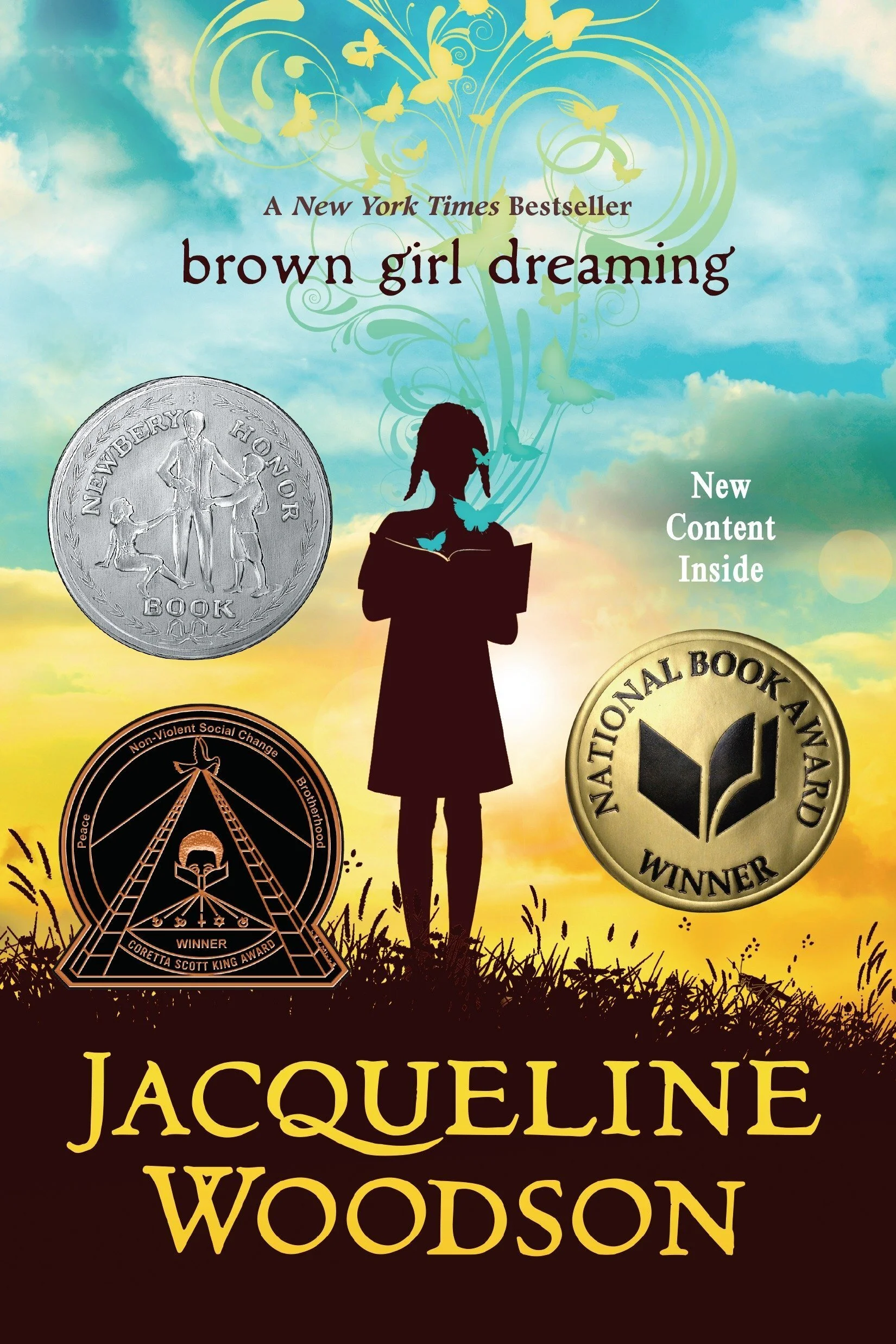


Some of the books I’m naming below are novels, memoirs, essays, or poems but all uniquely portray the topic of racial injustices against Black Americans. You’ll notice each link provided takes you to a source to read the author’s biography, a summary of the book, and to make a purchase. If you decide to purchase any of these books consider the links I’ve provided or a local bookstore. It’s important to use these sources as a powerful tool in prohibiting systemic racism in America, there is productive action to take alongside our reading lists.
Between The World And Me by Ta-Nehisi Coates
Brown Girl Dreaming by Jacqueline Woodson
Citizen: An American Lyric by Claudia Rankine
How To Be An Antiracist by Ibram X. Kendi
How We Fight for Our Lives by Saeed Jones
Notes from a Young Black Chef by Kwame Onwuachi
White Fragility: Why It's So Hard For White People To Talk About Racism by Robin DiAngelo
Sister Outsider by Audre Lorde
Survival Math: Notes on an All-American Family by Mitchell S. Jackson
The Autobiography Of Malcolm X by Malcolm X as told to Alex Haley
The Condemnation Of Blackness: Race, Crime And The Making Of Modern Urban America by Khalil Gibran Muhammad
The History Of White People by Nell Irvin Painter
The New Jim Crow: Mass Incarceration In The Age Of Colorblindness by Michelle Alexander